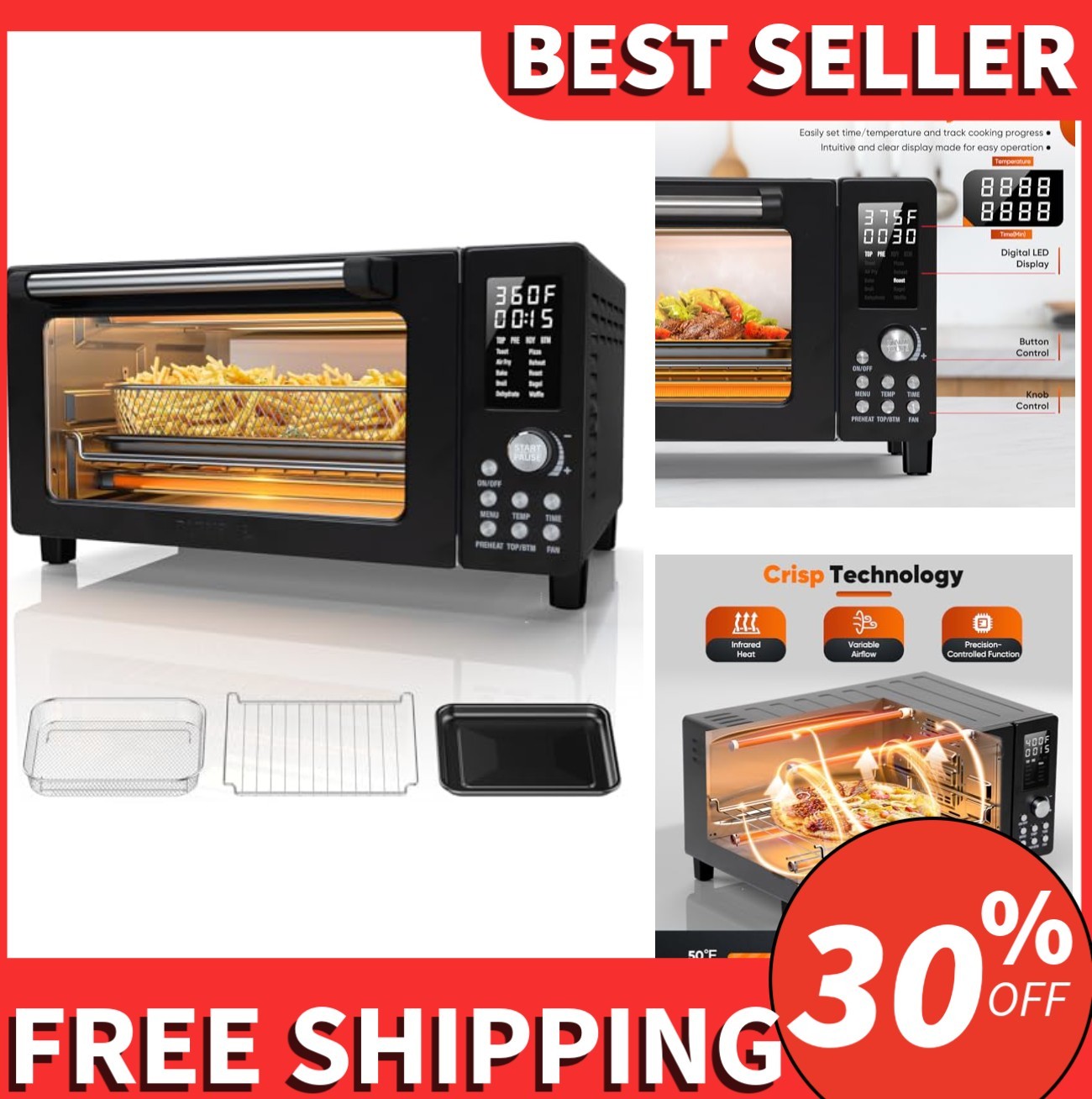

Photos from current listings. Actual item, color, and included accessories may vary.
Convection Oven Air Fryer Buying Guide
Convection oven air fryers are countertop ovens that combine a heating element with a high-speed fan to circulate hot air, producing crisp results without deep frying. The core trade-off is between pure air-fryer speed and the versatility of a larger convection oven cavity, with durability hinging on heating-element wattage, fan design, and interior coating quality. Choose a dedicated high-wattage air fryer for fast, small batches; choose a convection oven air fryer only when you need multi-rack baking, roasting, or toasting in one appliance.
Median $266.42 · New listings
Key takeaways
- True convection air frying requires a fan that moves at least 2,000 RPM and a heating element rated 1,500–1,800 W; lower wattage produces uneven, soggy results.
- Dual heating elements (top and bottom) with independent control outperform single-element designs for baking and roasting, while air-fry mode relies primarily on the top element plus fan.
- Interior coatings matter: ceramic or diamond-reinforced nonstick lasts longer than standard PTFE; exposed metal racks and crumb trays are easier to clean than coated ones.
At a glance
- Category
- Air Fryers
- Last updated
- Nov 28, 2026
Current offers

Highlights
- True convection air frying requires a fan that moves at least 2,000 RPM and a heating element rated 1,500–1,800 W; lower wattage produces uneven, soggy results.
- Dual heating elements (top and bottom) with independent control outperform single-element designs for baking and roasting, while air-fry mode relies primarily on the top element plus fan.
- Interior coatings matter: ceramic or diamond-reinforced nonstick lasts longer than standard PTFE; exposed metal racks and crumb trays are easier to clean than coated ones.
- Capacity tiers: 10–15 L models fit a 9-inch pizza or 2–3 lb chicken; 20–30 L models handle a 12-inch pizza or full sheet-pan meals but require more counter depth.
Best use cases
- Best fit: families needing multi-rack cooking (bake, roast, air-fry, toast) in one appliance — pick a 20–30 L dual-element convection oven air fryer with included wire racks and baking pan.
- Best fit: small households or couples focused on fast, crispy results — a 10–15 L model with 1,500 W+ and a high-speed fan delivers air-fry performance close to a basket-style fryer.
- Wrong fit: anyone expecting basket-air-fryer speed and crispness from a large oven — large cavities take longer to preheat and can dry out lean foods; skip if speed is the priority.
- Wrong fit: tight countertops with upper cabinets — most convection oven air fryers are 12–16 inches tall and need 4–6 inches of clearance above; measure before choosing a large tier.
Buying tips
- Match wattage to cavity size: 1,500–1,800 W for 10–15 L; 1,800–2,200 W for 20–30 L. Underpowered large ovens recover heat slowly and cook unevenly.
- Check fan placement: rear-wall convection fans distribute heat more evenly than top-mounted fans; rear fans are the standard for true convection baking.
- Prioritize mechanical or simple digital controls with separate temperature and function dials; touchscreens add failure points without improving cooking performance.
- Verify included accessories: at least two wire racks, a baking pan, and a crumb tray. Missing parts force costly add-on purchases and reduce usable capacity.
Specs
| Heating Power | 1,500–2,200 W by cavity size |
|---|---|
| Convection Type | Rear-fan true vs top-fan standard |
| Capacity Tier | 10–15 L compact / 20–30 L family |
| Interior Coating | Ceramic nonstick vs PTFE vs bare metal |
Related searches
What to check before buying
- Measure counter depth and height: allow 2–4 inches rear clearance for vents and 4–6 inches above; most models are 12–16 inches tall and 12–18 inches deep.
- Confirm electrical circuit: 1,800 W+ models draw 15 A and should run on a dedicated 20 A kitchen circuit to avoid tripping breakers with other appliances.
- Check interior dimensions against your cookware: a 12-inch pizza pan needs at least 13 inches of internal width; a 9×13 baking pan needs a 20 L+ cavity.
- Verify voltage and plug standard for your region: North American models are 120 V with NEMA 5-15P plugs; European/UK models are 220–240 V with Type F/G plugs — plug adapters do not convert voltage.
FAQ
Data sources: eBay / Amazon listings and product attribute feeds. Updated Nov 28, 2026.
Some links on this page are affiliate links. If you buy after clicking one, we may earn a commission at no extra cost to you. This does not change which products appear here or their order. Affiliate disclosure.