
Photos from current listings. Actual item, color, and included accessories may vary.
Immersion Blender Buying Guide
Immersion blenders are handheld motor-and-shaft tools that blend, puree, and emulsify directly in the pot, cup, or bowl. The core trade-off is motor architecture and shaft construction: DC/copper motors with metal couplings deliver sustained torque and durability, while budget AC motors with plastic bell housings and press-fit shafts overheat and strip under thick loads. Decide by wattage tier and blade-bell material—not by attachment count.
Median $60.99
Key takeaways
- Motor type defines duty cycle: copper-wound DC motors sustain 800–1000W for thick soups and frozen fruit; generic AC motors fade and overheat in 60–90 seconds of dense blending.
- Bell and shaft material separates tiers: stainless-steel bell plus metal shaft coupling survives daily hot-pot blending; plastic bell housings warp and crack near boiling liquids.
- Speed control granularity matters less than low-end torque—12 to 30 speeds are marketing splits of the same motor; variable trigger pressure is the real usability differentiator.
At a glance
- Category
- Blenders & Juicers
- Last updated
- Nov 27, 2026
Current offers
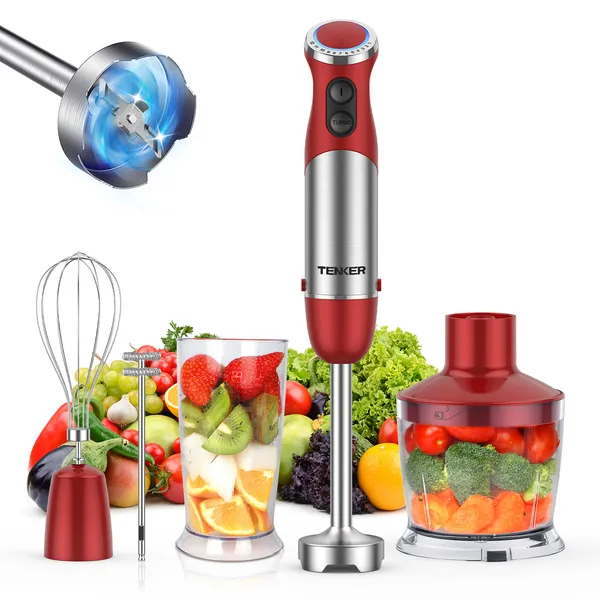 TENKER 5-in-1 Hand Immersion Blender, 1000W 12 Speed Handheld Copper Motor Stainless Steel Blade Stick Blender,600ml Mixing Beaker,500ml Food Processor, Whisk, Milk Frother, BPA-Free, Red$25.99View on Mallflare
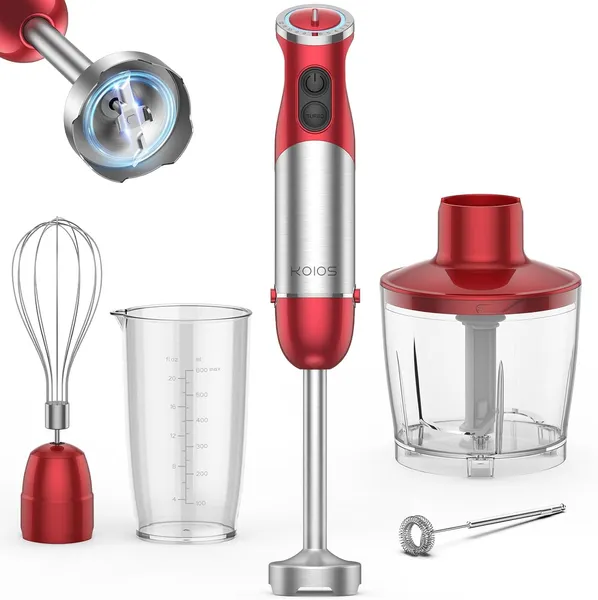 KOIOS 5-in-1 Hand Immersion Blender, 1000W 12 Speed Handheld Copper Motor Stainless Steel Blade Stick Blender,600ml Mixing Beaker,500ml Food Processor, Whisk, Milk Frother, BPA-Free, Red$60.99View on Mallflare
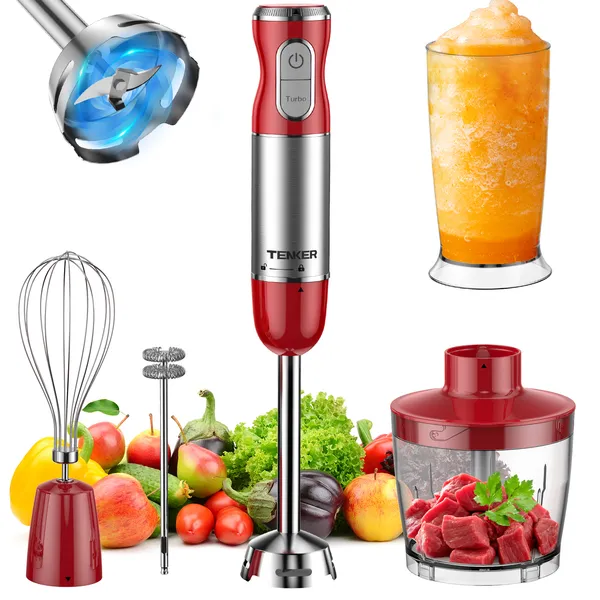 HB-2016A 5-in-1 Hand Immersion Blender, 30 Speeds Handheld Copper Motor Stainless Steel Blade Stick Blender,600ml Mixing Beaker,500ml Food Processor, Whisk, Milk Frother, BPA-Free, Red$63.99View on Mallflare
Highlights
- Motor type defines duty cycle: copper-wound DC motors sustain 800–1000W for thick soups and frozen fruit; generic AC motors fade and overheat in 60–90 seconds of dense blending.
- Bell and shaft material separates tiers: stainless-steel bell plus metal shaft coupling survives daily hot-pot blending; plastic bell housings warp and crack near boiling liquids.
- Speed control granularity matters less than low-end torque—12 to 30 speeds are marketing splits of the same motor; variable trigger pressure is the real usability differentiator.
- Attachment sets are standardized: 600ml beaker, 500ml chopper bowl, whisk, and milk frother are commodity add-ons—judge the blender by the motor and bell, not the accessory count.
Best use cases
- Best fit for daily soup pureeing: pick a 700–1000W copper-motor stick with a stainless bell and detachable metal shaft; skip low-wattage plastic-bell units that warp in hot pots.
- Best fit for mini/single-serve tasks (smoothies, frothing, baby food): a compact 300–500W stick with a short shaft and 600ml beaker is sufficient; skip 1000W full-size units that are too long for cups.
- Wrong fit for crushing ice or grinding dry spices: immersion blenders lack the jar geometry and blade mass—use a countertop blender; skip immersion models marketed with ice-crushing claims.
- Best fit for small kitchens with limited storage: a 5-in-1 kit with nested beaker and chopper bowl covers puree, chop, whip, and froth; skip if you only blend soups—a bare stick stores smaller.
Buying tips
- Match wattage to food density: 200–400W for smoothies and frothing, 500–700W for sauces and baby food, 800W+ for thick soups and frozen fruit. Wattage is the primary performance tier.
- Require a stainless-steel bell and a metal (not plastic) shaft coupling; these two parts fail first on budget units and determine whether the blender survives weekly hot-pot use.
- Shaft length must exceed your deepest pot's liquid depth by at least 2 inches so the motor housing stays above the rim and splatter is contained.
- Prefer detachable shafts and bell—fixed-shaft models trap food in the seam and cannot be fully cleaned; detachable parts are also replaceable if damaged.
Specs
| Motor Type | Copper DC vs generic AC |
|---|---|
| Wattage Tier | 300W mini / 700W daily / 1000W heavy |
| Bell & Shaft | Stainless detachable vs plastic fixed |
| Kit Contents | Bare stick vs 5-in-1 beaker/chopper |
Related searches
What to check before buying
- Measure your tallest pot and tallest cup: shaft length plus bell must reach the bottom with the motor body clear of the rim by 2 inches.
- Confirm your wall voltage and plug standard (120V US vs 220–240V EU/UK); most immersion blenders are region-specific and not dual-voltage.
- Check beaker and chopper bowl volumes against your typical batch: 600ml beaker suits single servings; 1L+ batches need a pot, not the beaker.
- Verify the bell and shaft are dishwasher-safe and detachable—fixed or non-detachable heads must be hand-washed and are a cleaning bottleneck.
FAQ
Data sources: eBay / Amazon listings and product attribute feeds. Updated Nov 27, 2026.
Some links on this page are affiliate links. If you buy after clicking one, we may earn a commission at no extra cost to you. This does not change which products appear here or their order. Affiliate disclosure.