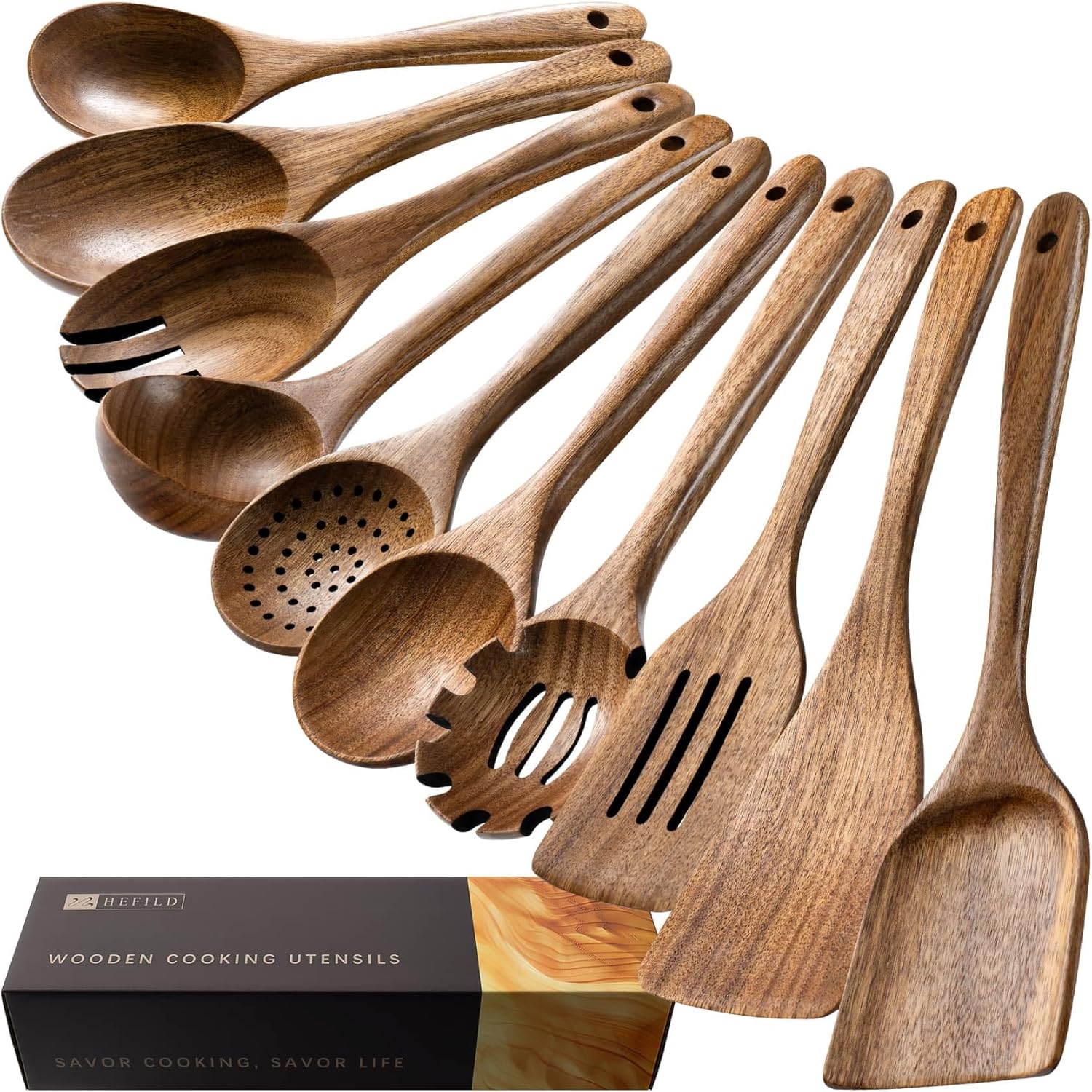

Photos from current listings. Actual item, color, and included accessories may vary.
Cooking Spoon Buying Guide
A cooking spoon is a primary stirring, serving, and tasting tool where the core trade-off is heat resistance and non-scratch safety versus rigidity and stain resistance. Wood and silicone protect nonstick coatings but absorb odors or degrade at high heat; stainless steel is indestructible but scratches delicate surfaces. The decision rule: match spoon material to your cookware's coating and your stove's heat output—buy silicone or wood for nonstick, stainless for stainless/cast iron, and avoid plastic at sustained high heat.
Key takeaways
- Silicone spoons rated to 450–600°F protect nonstick coatings; below 450°F they deform on wok or searing heat.
- Acacia and beech wood spoons are hard, closed-grain, and heat-insulating but require hand washing to prevent cracking and odor absorption.
- Stainless steel spoons are dishwasher-safe and non-porous but will scratch PTFE and ceramic nonstick; use only on bare metal, cast iron, or glass.
At a glance
- Category
- Food Preparation
- Last updated
- Nov 28, 2026
Current offers
Highlights
- Silicone spoons rated to 450–600°F protect nonstick coatings; below 450°F they deform on wok or searing heat.
- Acacia and beech wood spoons are hard, closed-grain, and heat-insulating but require hand washing to prevent cracking and odor absorption.
- Stainless steel spoons are dishwasher-safe and non-porous but will scratch PTFE and ceramic nonstick; use only on bare metal, cast iron, or glass.
- One-piece molded silicone (no seams or attached heads) outlasts two-piece wood-handle silicone spoons that loosen or harbor water at the joint.
Best use cases
- Best for nonstick skillets and enameled Dutch ovens: choose one-piece silicone spoons rated 450°F+ or smooth acacia wood—skip metal entirely.
- Best for stainless steel and cast iron searing: pick solid stainless steel spoons for rigidity and easy sanitizing; silicone is optional for high-heat stirring only.
- Best for daily all-around stirring and serving on a budget: a 3–5 piece acacia or beech wood set covers sautéing, serving, and baking; skip oversized 35-piece kits unless outfitting a new kitchen.
- Wrong fit: thin plastic spoons and painted or varnished wood—they warp, chip, or leach at sustained heat; avoid for wok cooking and dishwasher cycles.
Buying tips
- Match spoon material to coating: silicone or wood for PTFE/ceramic nonstick, stainless steel for uncoated stainless, cast iron, and glass.
- Check the silicone temperature rating: 450°F minimum for stovetop stirring, 550–600°F for wok and searing use; unrated silicone is a compromise.
- For wood, choose hard closed-grain species (acacia, beech, teak) over soft pine; thick handles (0.6–0.8 in) resist splitting better than thin ones.
- Prefer one-piece molded silicone or full-tang stainless construction; two-piece wood-handle silicone spoons loosen and trap water at the joint over time.
Specs
| Spoon Material | Silicone / Acacia wood / Stainless steel |
|---|---|
| Heat Resistance | Wood: no limit / Silicone: 450–600°F |
| Nonstick Safe | Silicone & wood yes / metal no |
| Dishwasher Safe | Silicone & steel yes / wood no |
Related searches
What to check before buying
- Measure your cookware depth and rim height: spoon handle length should exceed pot depth by at least 2–3 in to keep hands clear of steam and heat.
- Confirm your cookware coating (PTFE, ceramic, enamel, bare stainless, cast iron) before choosing metal versus silicone or wood.
- Check dishwasher availability: wood and two-piece silicone spoons are hand-wash only; stainless and one-piece silicone are dishwasher-safe.
- Verify stove heat output: gas wok burners and high-BTU searing exceed 450°F at the pan surface, requiring 550°F+ silicone or metal.
FAQ
Data sources: eBay / Amazon listings and product attribute feeds. Updated Nov 28, 2026.
Some links on this page are affiliate links. If you buy after clicking one, we may earn a commission at no extra cost to you. This does not change which products appear here or their order. Affiliate disclosure.