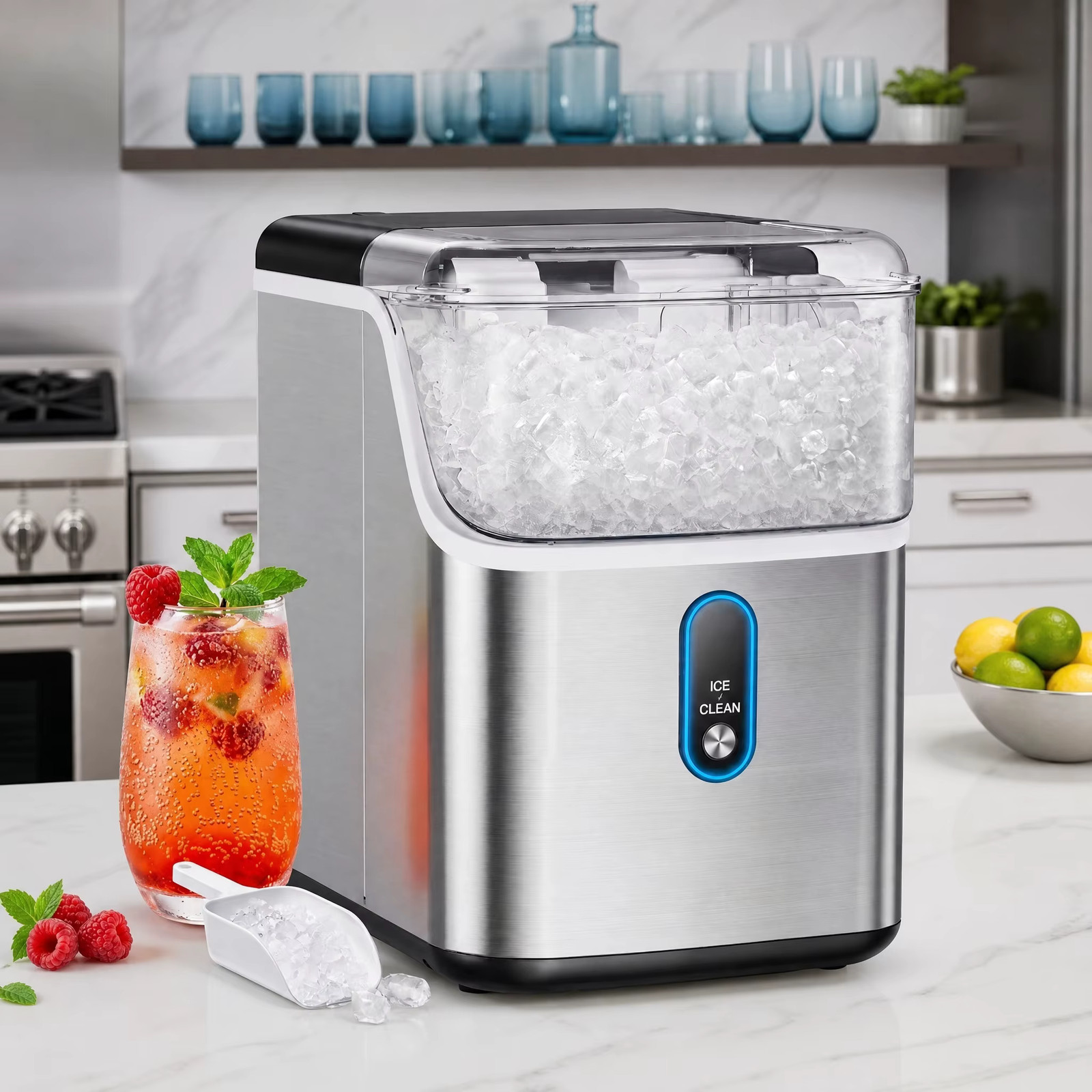

Photos from current listings. Actual item, color, and included accessories may vary.
Pebble Ice Machine Buying Guide
A pebble ice machine produces soft, chewable nugget or pellet ice by extruding and compacting flake ice through a heated auger—unlike cube makers that freeze clear blocks in molds. The core trade-off is between continuous auger-driven output with higher energy draw and simpler cube-tray designs that cost less but yield hard, slow ice. Buy a pebble machine only if chewable texture and continuous supply matter; skip it if you need high-volume clear cubes or the lowest possible power draw.
Key takeaways
- Nugget architecture uses a stainless auger and extruder head, not evaporator trays, so ice is soft and chewable rather than clear and hard.
- Countertop units typically run 30-45 lb/day with 1-3 lb internal bins, requiring 2-4 refills daily for household use.
- Undercounter pebble machines deliver 50-90 lb/day and need a dedicated water line and drain—not a reservoir refill.
At a glance
- Category
- Ice Makers
- Last updated
- Nov 28, 2026
Current offers
Highlights
- Nugget architecture uses a stainless auger and extruder head, not evaporator trays, so ice is soft and chewable rather than clear and hard.
- Countertop units typically run 30-45 lb/day with 1-3 lb internal bins, requiring 2-4 refills daily for household use.
- Undercounter pebble machines deliver 50-90 lb/day and need a dedicated water line and drain—not a reservoir refill.
- Continuous auger motors draw 150-300W and run whenever the bin calls for ice, so energy use is higher than batch cube makers.
Best use cases
- Best fit: a household of 2-4 that wants chewable nugget ice for drinks and will refill a 1-3 lb countertop bin 2-3 times daily—pick a 33-45 lb/day countertop model.
- Best fit: a home bar or kitchen with a water line and drain that needs 50+ lb/day continuous supply—pick an undercounter pebble machine, not a countertop reservoir unit.
- Wrong fit: a buyer who mainly needs large clear cubes for cocktails or coolers—a cube maker produces harder, slower-melting ice at lower power draw.
- Wrong fit: an RV, boat, or off-grid setup—auger pebble machines need stable AC power and most lack 12V options; choose a compact cube maker instead.
Buying tips
- Match daily output to household size: 2 people need 25-35 lb/day, 4 people need 35-50 lb/day, and entertaining pushes to 50+ lb/day undercounter units.
- Check bin capacity: countertop bins hold 1-3 lb, so a 33 lb/day unit with a 2 lb bin needs roughly 3 refills per day at full output.
- Prefer stainless steel auger and evaporator components over aluminum or coated parts; stainless resists mineral scale and extends motor life.
- For undercounter models, confirm a 1/4-inch water line and gravity or pump drain are available at the install spot—reservoir-only countertop units avoid this.
Specs
| Ice Type | Nugget / pebble / pellet (soft chewable) |
|---|---|
| Daily Output | 30-45 lb (countertop) / 50-90 lb (undercounter) |
| Bin Capacity | 1-3 lb countertop / 5-10 lb undercounter |
| Water Supply | Reservoir refill vs 1/4-in line + drain |
Related searches
What to check before buying
- Measure countertop depth and height: most countertop pebble makers are 10-13 inches wide and 12-16 inches tall, so confirm clearance under cabinets.
- For undercounter installs, verify a 15- or 18-inch cutout width plus front-vent airflow clearance of at least 2 inches.
- Check water hardness: above 10 grains per gallon, plan for a scale filter or softened feed water to protect the auger and evaporator.
- Confirm the outlet is a standard 115V grounded circuit and that the unit is not sharing a circuit with high-draw appliances.
FAQ
Data sources: eBay / Amazon listings and product attribute feeds. Updated Nov 28, 2026.
Some links on this page are affiliate links. If you buy after clicking one, we may earn a commission at no extra cost to you. This does not change which products appear here or their order. Affiliate disclosure.