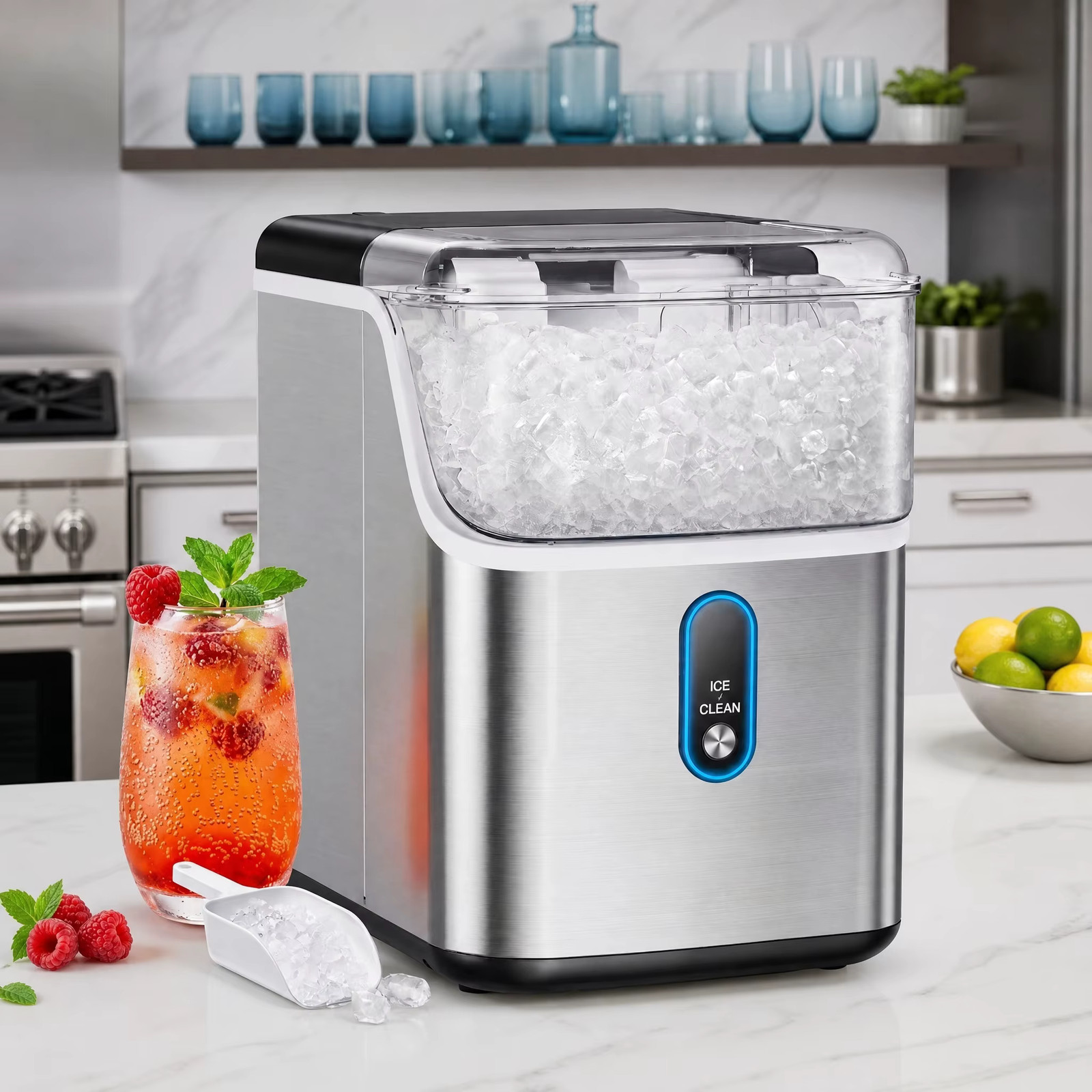

Photos from current listings. Actual item, color, and included accessories may vary.
Pebble Ice Maker Buying Guide
Pebble ice makers (also called nugget or pellet ice makers) produce soft, chewable ice by compressing flaked ice into small irregular nuggets. The key trade-off is between the convenience of chewable ice and the maintenance burden of the auger-and-extruder mechanism, which requires regular descaling. Choose a model with a stainless-steel auger, a self-cleaning cycle, and a sufficiently large daily output, not the cheapest plastic-auger unit.
Key takeaways
- Nugget ice is made by a flake-ice evaporator cylinder and an auger that compresses wet flakes through an extruder; this mechanism is distinct from cube-ice molds.
- Daily output for countertop pebble makers typically ranges from 25 to 45 lb per day, with storage bins holding 1.5 to 3 lb of ready ice.
- Stainless-steel augers and evaporator cylinders resist mineral scale and last longer than plastic or coated-aluminum assemblies.
At a glance
- Category
- Ice Makers
- Last updated
- Nov 28, 2026
Current offers
Highlights
- Nugget ice is made by a flake-ice evaporator cylinder and an auger that compresses wet flakes through an extruder; this mechanism is distinct from cube-ice molds.
- Daily output for countertop pebble makers typically ranges from 25 to 45 lb per day, with storage bins holding 1.5 to 3 lb of ready ice.
- Stainless-steel augers and evaporator cylinders resist mineral scale and last longer than plastic or coated-aluminum assemblies.
- Self-cleaning cycles and replaceable water filters are the primary defenses against the scale and biofilm that clog nugget-ice machines.
Best use cases
- Best fit for home kitchens and home bars: pick a countertop model with 30–45 lb daily output and a 2–3 lb bin if you serve 2–4 people daily.
- Best fit for entertaining or small offices: choose a unit with a larger bin and a continuous-drain option, and skip low-output models under 25 lb per day.
- Wrong fit for commercial or high-volume use: countertop pebble makers are not designed for continuous duty; choose a commercial nugget-ice machine with a remote condenser instead.
- Wrong fit for renters or tiny kitchens with no nearby outlet and drain: skip plumbed or drain-line models and choose a manual-fill countertop unit with a removable bin.
Buying tips
- Size by daily output: allow roughly 1 lb of ice per person per day for drinks, and choose at least 30 lb per day for a household of four.
- Check the auger and evaporator materials: stainless steel resists scale and wear; plastic or coated augers degrade faster and can shed material into ice.
- Prioritize a self-cleaning cycle and a replaceable water filter; nugget machines are harder to descale than cube makers because of the auger assembly.
- Confirm the unit has a standard NEMA 5-15 plug and draws under 15 A; most countertop pebble makers run on 120 V and need a dedicated 15 A circuit.
Specs
| Ice Type | Nugget / pebble / chewable pellet |
|---|---|
| Daily Output | 25–45 lb per day (countertop) |
| Bin Capacity | 1.5–3 lb ready ice |
| Auger Material | Stainless steel vs plastic/coated |
Related searches
What to check before buying
- Measure the countertop footprint and required clearance: most pebble makers need 2–4 inches of rear and side space for airflow, plus headroom to open the bin lid.
- Verify a nearby grounded 120 V outlet on a 15 A circuit; avoid sharing the circuit with high-draw appliances.
- Check the bin capacity against your daily use: a 1.5 lb bin suits one or two people, while 3 lb or more suits families and entertaining.
- Decide between manual-fill and plumbed water: plumbed units require a water-line connection, while manual-fill units need refilling every 1–2 days.
FAQ
Data sources: eBay / Amazon listings and product attribute feeds. Updated Nov 28, 2026.
Some links on this page are affiliate links. If you buy after clicking one, we may earn a commission at no extra cost to you. This does not change which products appear here or their order. Affiliate disclosure.