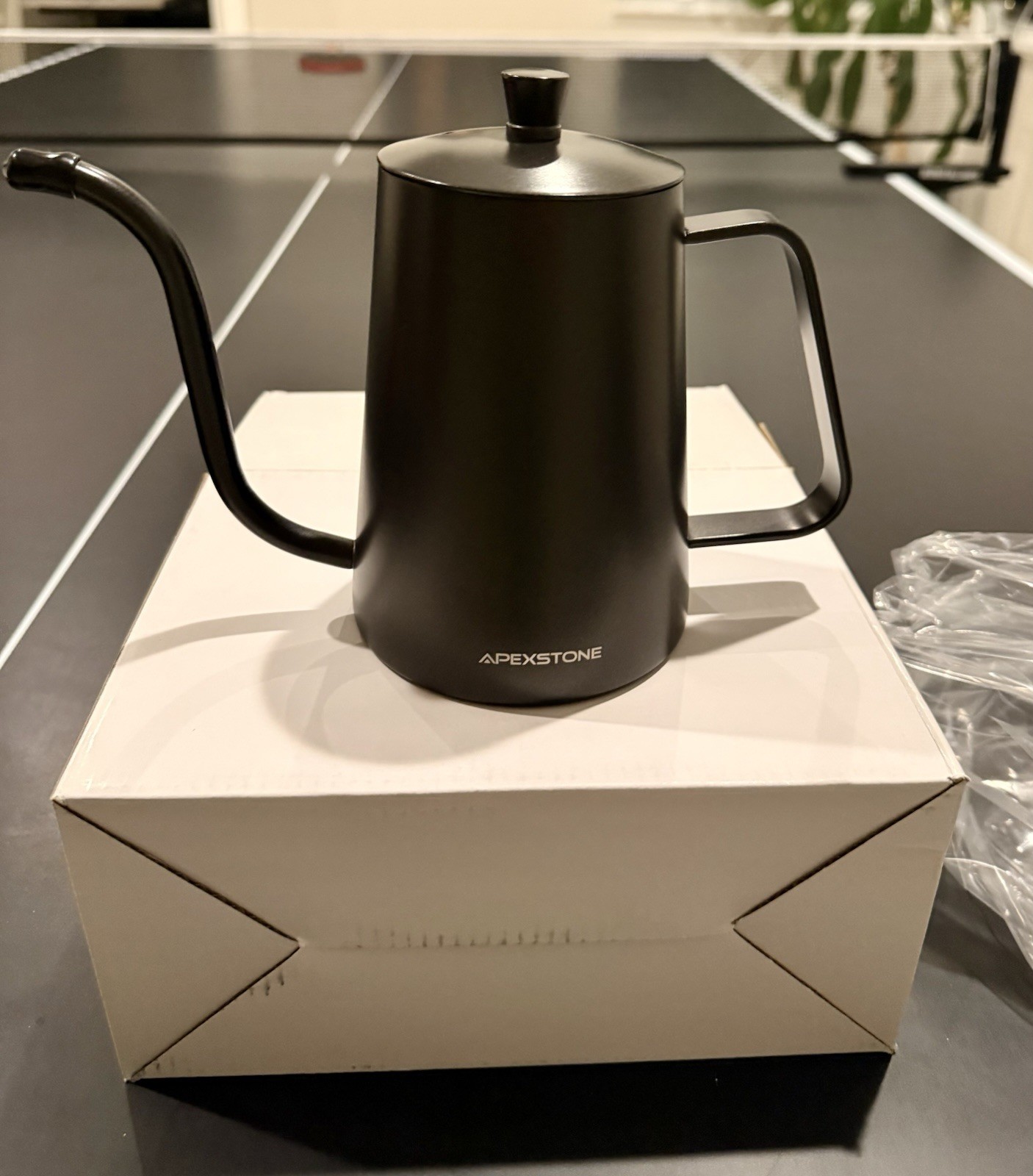

Photos from current listings. Actual item, color, and included accessories may vary.
Pour Over Tea Kettle Buying Guide
A pour-over tea kettle is a specialized vessel with a narrow gooseneck spout engineered to deliver a slow, steady, and precise stream of water over coffee grounds or tea leaves. The core trade-off is between thermal retention (double-wall vacuum insulation vs. single-wall construction) and pour control, which depends on spout geometry and handle balance. Buyers should choose a kettle with a true gooseneck spout, a comfortable counterweighted handle, and a capacity matched to their brewing volume—not a modified electric kettle with a wide spout.
Key takeaways
- Gooseneck spout inner diameter typically 6–10 mm; narrower spouts (6–8 mm) give finer flow control for tea and light-roast coffee, while wider spouts (9–10 mm) suit faster pours.
- Single-wall 304 stainless steel kettles heat fast on any stovetop (gas, electric, induction) but lose temperature quickly; double-wall vacuum kettles hold heat for 30–60 minutes but are not stovetop-safe.
- Electric gooseneck kettles offer set-temperature control (±1–2°F) and hold functions, ideal for green tea (160–180°F) and oolong (185–200°F); stovetop models require a separate thermometer.
At a glance
- Category
- Pour-Over & Manual Brewing
- Last updated
- Nov 23, 2026
Current offers
Highlights
- Gooseneck spout inner diameter typically 6–10 mm; narrower spouts (6–8 mm) give finer flow control for tea and light-roast coffee, while wider spouts (9–10 mm) suit faster pours.
- Single-wall 304 stainless steel kettles heat fast on any stovetop (gas, electric, induction) but lose temperature quickly; double-wall vacuum kettles hold heat for 30–60 minutes but are not stovetop-safe.
- Electric gooseneck kettles offer set-temperature control (±1–2°F) and hold functions, ideal for green tea (160–180°F) and oolong (185–200°F); stovetop models require a separate thermometer.
- Capacity ranges from 20 oz (single 8–10 oz cup) to 34 oz (two 12 oz servings); a 30 oz kettle covers most pour-over and tea sessions without excess weight when full.
Best use cases
- Best fit: Daily pour-over coffee or loose-leaf tea for one or two people—choose a 27–30 oz gooseneck with a counterbalanced handle and a built-in thermometer or electric temperature control.
- Best fit: Travel or office use—pick a compact 20–24 oz single-wall stainless kettle with a tight-fitting lid and no fragile glass components.
- Wrong fit: High-volume batch brewing (more than 34 oz per session) or continuous tea service—skip small gooseneck kettles and use a larger brew kettle or urn instead.
- Wrong fit: Induction cooktop owners who buy a double-wall vacuum kettle—vacuum kettles are not stovetop-safe; choose a single-wall magnetic stainless (18/0 or 304) model instead.
Buying tips
- Match capacity to your brew: 20 oz for a single 8–10 oz cup, 27–30 oz for two cups or a 16–20 oz tea pot, and 34 oz only if you regularly brew for three or more.
- Check spout attachment: a welded or seamless gooseneck resists leaking and mineral buildup better than a press-fit spout, which can loosen over time.
- For electric models, confirm temperature range covers 140–212°F with ±2°F accuracy and a hold time of at least 30 minutes; variable presets for tea types are a plus.
- Verify base compatibility: single-wall stainless kettles work on gas, electric coil, ceramic, and induction only if marked magnetic (18/0 or 304 with magnetic base).
Specs
| Spout Type | Gooseneck 6–10 mm inner diameter |
|---|---|
| Wall Construction | Single-wall stovetop / Double-wall vacuum |
| Capacity Range | 20–34 oz (0.6–1.0 L) |
| Heat Source | Gas / Electric / Induction / Electric base |
Related searches
What to check before buying
- Measure your brewing vessel: the kettle spout must reach over the dripper or teapot rim without the body touching the cup—check spout length and handle clearance.
- Confirm stovetop type: induction requires a magnetic base; glass-top electric requires a flat, stable bottom; gas works with any single-wall kettle.
- Check your water source: hard water causes scale in narrow gooseneck spouts—plan to descale monthly with citric acid or vinegar.
- Verify handle material and heat resistance: silicone or wood handles stay cool on stovetop models; all-metal handles require a towel or glove.
FAQ
Data sources: eBay / Amazon listings and product attribute feeds. Updated Nov 23, 2026.
Some links on this page are affiliate links. If you buy after clicking one, we may earn a commission at no extra cost to you. This does not change which products appear here or their order. Affiliate disclosure.