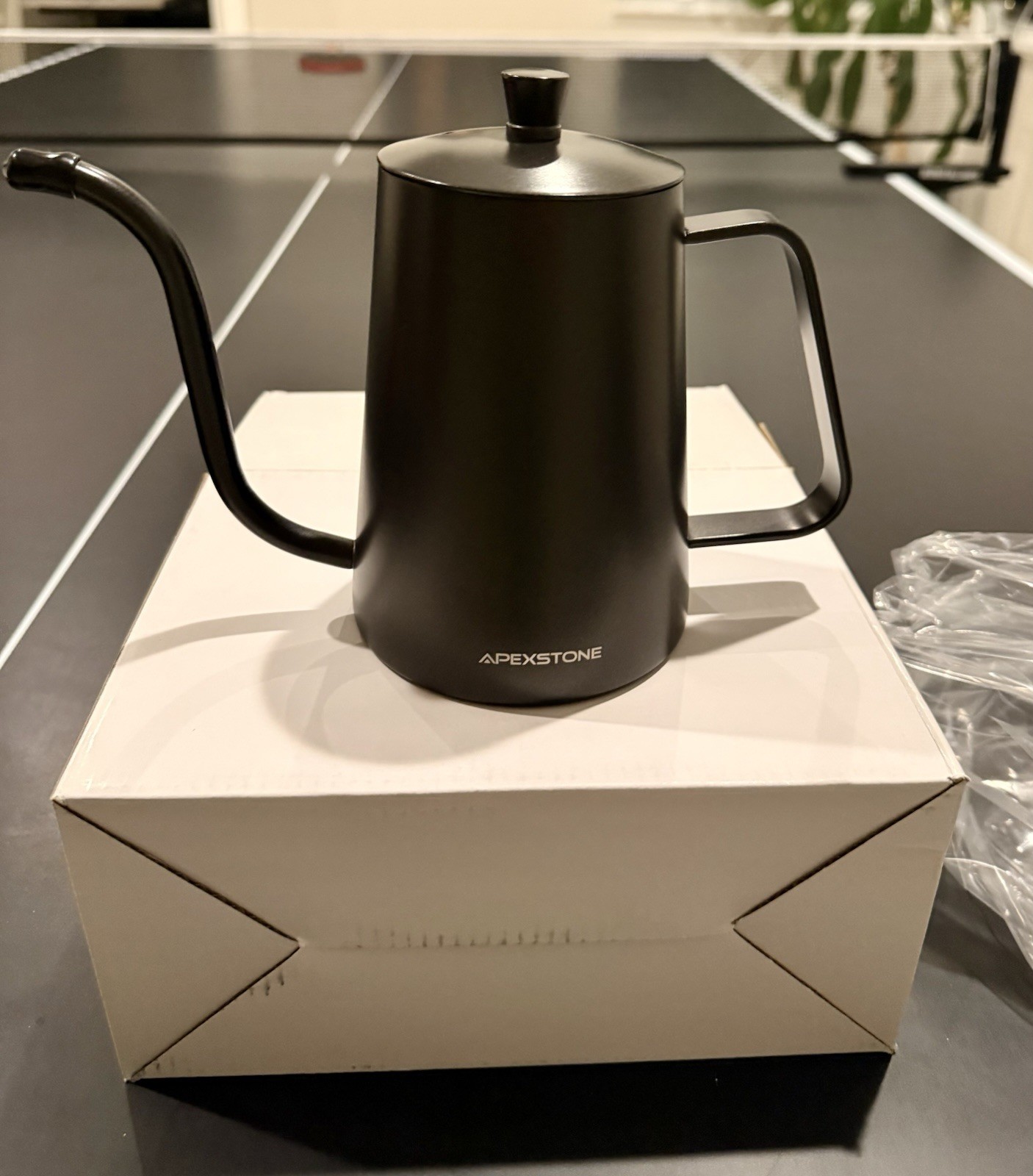

Photos from current listings. Actual item, color, and included accessories may vary.
Tea Kettle Buying Guide
A tea kettle for pour-over coffee is a precise water-delivery tool, not a generic stovetop boiler. The core trade-off is spout control versus heating speed: a long, narrow gooseneck gives laminar flow for even extraction, while wide spouts and thin walls dump water too fast. Buy a gooseneck with a balanced handle and a capacity matched to your brew volume; skip decorative or multi-purpose kettles that lack flow control.
Key takeaways
- Gooseneck spout inner diameter of 6-8 mm and a gradual taper deliver a controlled 8-12 g/s stream; wider or stepped spouts cause turbulence and channeling.
- Stainless steel 304 (18/8) body with a fully welded or seamless spout resists scale buildup and seam leaks; 201-grade or spot-welded spouts fail at the joint over time.
- Variable-temperature electric bases hold setpoint within ±2°F (±1°C) via PID control; stovetop kettles rely on an external thermometer and lose 5-10°F during the pour.
At a glance
- Category
- Pour-Over & Manual Brewing
- Last updated
- Nov 23, 2026
Current offers
Highlights
- Gooseneck spout inner diameter of 6-8 mm and a gradual taper deliver a controlled 8-12 g/s stream; wider or stepped spouts cause turbulence and channeling.
- Stainless steel 304 (18/8) body with a fully welded or seamless spout resists scale buildup and seam leaks; 201-grade or spot-welded spouts fail at the joint over time.
- Variable-temperature electric bases hold setpoint within ±2°F (±1°C) via PID control; stovetop kettles rely on an external thermometer and lose 5-10°F during the pour.
- A 30 oz (0.9 L) capacity brews two 10-12 oz cups with headroom; 1.0 L models add pour weight, while sub-20 oz travel kettles force refills mid-brew.
Best use cases
- Best fit: home pour-over with a gooseneck electric kettle (variable temp, 0.9-1.0 L) for daily V60 or Chemex brewing—precise flow and repeatable temperature.
- Best fit: stovetop gooseneck (304 stainless, 0.9-1.2 L) for gas or induction ranges when counter space or budget rules out an electric base; pair with a separate thermometer.
- Wrong fit: a wide-spout whistling tea kettle or a 1.7 L general-purpose kettle—water arrives too fast and too heavy for a controlled bloom and spiral pour.
- Wrong fit: a 20-30 oz travel kettle for batch brewing—capacity forces a second boil and temperature drops between pours.
Buying tips
- Match capacity to brew volume: 0.9-1.0 L covers 2-4 cups; choose 1.2 L only if you regularly brew 1 L batches, since full kettles are heavy and slow to control.
- For electric models, confirm PID variable temperature (140-212°F) and a hold function; fixed-temperature kettles force you to guess off-boil rest times.
- For stovetop, verify base diameter matches your burner (6-8 in) and that the body is induction-compatible if you cook on induction—304 stainless alone is not always magnetic.
- Check handle material and attachment: heat-resistant phenolic or silicone-wrapped handles with riveted or bolted mounts stay cooler and tighter than glued or thin stamped handles.
Specs
| Spout Type | Gooseneck 6-8 mm / Standard wide |
|---|---|
| Heat Source | Electric PID base / Stovetop gas-induction |
| Body Material | 304 stainless / 201-grade / enamel |
| Capacity | 0.9-1.0 L typical / 0.5-1.2 L range |
Related searches
What to check before buying
- Measure your brewer and carafe height: a long gooseneck needs 4-6 in of clearance above the dripper, and the kettle spout must reach the center without tilting the body.
- Confirm your heat source: electric kettles need a free outlet near the brew station; stovetop kettles need a matching burner size and induction compatibility if applicable.
- Weigh the full kettle: a 1.0 L stainless kettle filled weighs roughly 2.5-3 lb—ensure the handle and your wrist can sustain a 2-3 minute pour.
- Check spout and lid fit: a tight lid prevents temperature loss and accidental spill; a spout that drips after pouring indicates poor lip geometry.
FAQ
Data sources: eBay / Amazon listings and product attribute feeds. Updated Nov 23, 2026.
Some links on this page are affiliate links. If you buy after clicking one, we may earn a commission at no extra cost to you. This does not change which products appear here or their order. Affiliate disclosure.