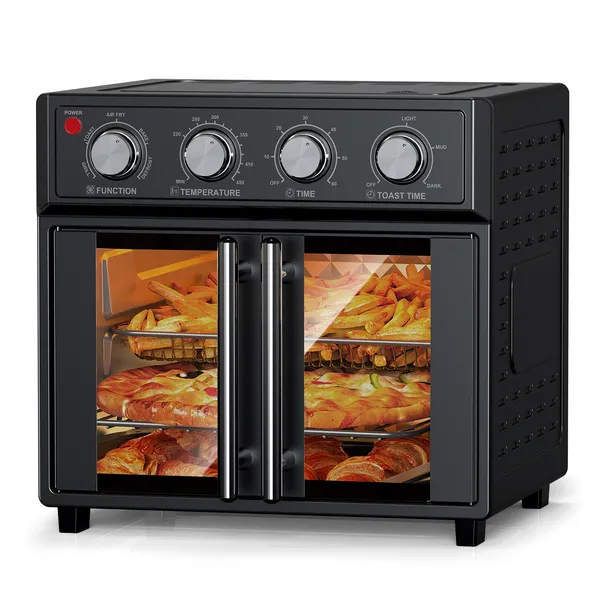

Photos from current listings. Actual item, color, and included accessories may vary.
Large Slice Toaster Buying Guide
Large-slice toasters are defined by slot length and wattage: long-slot models (10-11 in) accept artisan bread, bagels, and Texas toast without jamming, while standard 2-slot units max out at 5.5 in. The core trade-off is slot geometry and heating element quality versus counter footprint and price tier. Buy a long-slot unit with independent slot controls and a manual lift lever if you regularly toast oversized slices; skip 2-slot pop-ups entirely for that job.
Key takeaways
- Long-slot toasters use 10-11 in slot lengths versus 5.5 in on standard 2-slot models, the single spec that determines whether artisan loaves fit.
- Wattage drives recovery speed: 1300-1800 W long-slot units toast two thick slices in one cycle, while sub-900 W units brown unevenly and require second passes.
- Independent slot controls (separate browning dials and levers per pair) let you run one bagel half and one thin slice simultaneously without compromise.
At a glance
- Category
- Toasters & Ovens
- Last updated
- Nov 28, 2026
Current offers
Highlights
- Long-slot toasters use 10-11 in slot lengths versus 5.5 in on standard 2-slot models, the single spec that determines whether artisan loaves fit.
- Wattage drives recovery speed: 1300-1800 W long-slot units toast two thick slices in one cycle, while sub-900 W units brown unevenly and require second passes.
- Independent slot controls (separate browning dials and levers per pair) let you run one bagel half and one thin slice simultaneously without compromise.
- Extra-lift or manual lift levers raise small items above the slot rim, a mechanical feature absent on budget motorized pop-ups that drop items out of reach.
Best use cases
- Buy a 4-slot long-slot toaster if your household toasts 4+ slices at breakfast and regularly handles bagels or Texas toast; skip 2-slot units that force batch toasting.
- Choose a 2-slot long-slot model for small kitchens where a 4-slot unit would monopolize counter space; it still clears 10-in artisan slices.
- Skip large-slice toasters entirely if you only toast standard sandwich bread and value counter space; a compact 2-slot unit at 5.5 in slots does the job for less.
Buying tips
- Measure your bread first: slot length of 10-11 in clears most artisan loaves, while 5.5-6 in slots handle only standard sandwich bread.
- Match wattage to slice thickness: 1300 W+ long-slot toasters recover heat fast enough for back-to-back thick slices; under 900 W units stall on the second batch.
- Check slot width (minimum 1.5 in) for bagels and Texas toast; narrow 1-in slots pinch thick slices and cause uneven browning.
- Prefer mechanical lever pop-ups over motorized ones for long slots; levers are field-serviceable and avoid the motor failure that strands bread mid-cycle.
Specs
| Slot Length | 10-11 in long-slot vs 5.5-6 in standard |
|---|---|
| Wattage | 1300-1800 W long-slot / 900 W budget |
| Slot Width | 1.5 in min for bagels / 1 in thin |
| Slot Controls | Independent pairs vs single dial |
Related searches
What to check before buying
- Measure counter depth and overhead clearance: 4-slot long-slot units run 12-16 in wide and need 3-4 in clearance above for lever travel.
- Confirm your bread dimensions: slice length up to 10-11 in and thickness up to 1.5 in fit long-slot models; anything larger needs a toaster oven.
- Verify outlet and circuit load: 1500-1800 W units draw 12.5-15 A and should run on a dedicated 15 A kitchen circuit, not a shared GFCI strip.
- Check crumb tray accessibility and cord length (typically 30-36 in) against your outlet position before committing to a footprint.
FAQ
Data sources: eBay / Amazon listings and product attribute feeds. Updated Nov 28, 2026.
Some links on this page are affiliate links. If you buy after clicking one, we may earn a commission at no extra cost to you. This does not change which products appear here or their order. Affiliate disclosure.