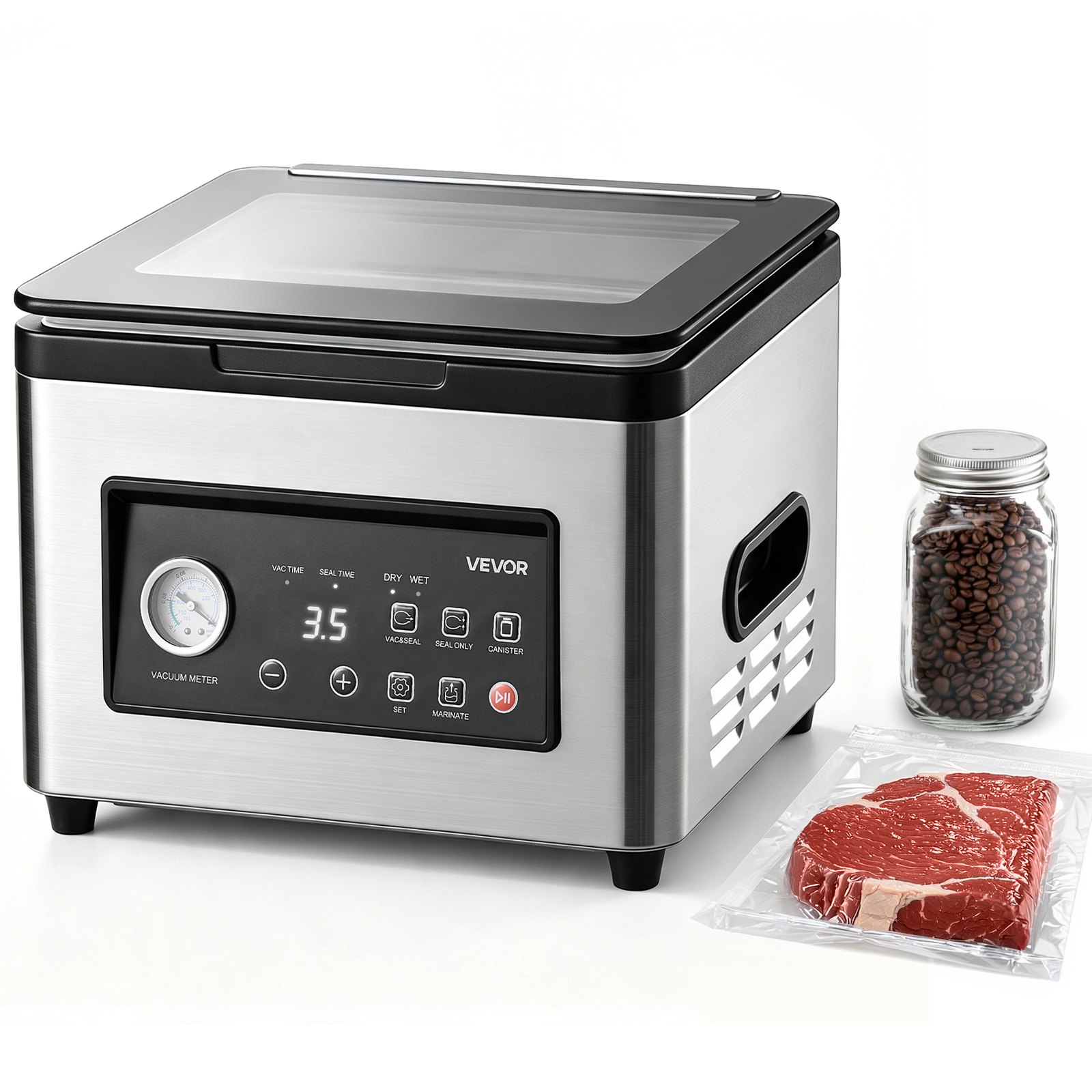

Photos from current listings. Actual item, color, and included accessories may vary.
Commercial Chamber Vacuum Sealer Buying Guide
A commercial chamber vacuum sealer places the entire bag and product inside a rigid chamber, then evacuates the chamber itself—allowing liquids, marinades, and wet foods to be sealed without being drawn into the pump. The core trade-off is pump architecture and chamber volume: oil-filled rotary-vane pumps deliver deep, continuous vacuum for high-volume wet sealing, while dry pumps and smaller chambers cut cost but limit duty cycle and bag size. Choose a chamber sealer only if you routinely seal liquids or volume; otherwise a quality external suction sealer remains the smarter buy.
Key takeaways
- Chamber sealers use oil-filled rotary-vane pumps rated for continuous duty and deep vacuum (typically 99%+ evacuation), unlike dry piston pumps that overheat and fail under wet, repetitive loads.
- Chamber volume—not bag width—sets maximum product size: a 10x13-inch chamber fits 8x12-inch bags, while 12x15-inch chambers accept 10x13-inch bags for larger cuts.
- Bar-style seal bars (single or double) and seal width (typically 3-10mm) determine seal integrity on thick or wet bags; double 5mm bars outperform 3mm single bars for heavy commercial cycles.
At a glance
- Category
- Vacuum Sealers
- Last updated
- Nov 28, 2026
Current offers
Highlights
- Chamber sealers use oil-filled rotary-vane pumps rated for continuous duty and deep vacuum (typically 99%+ evacuation), unlike dry piston pumps that overheat and fail under wet, repetitive loads.
- Chamber volume—not bag width—sets maximum product size: a 10x13-inch chamber fits 8x12-inch bags, while 12x15-inch chambers accept 10x13-inch bags for larger cuts.
- Bar-style seal bars (single or double) and seal width (typically 3-10mm) determine seal integrity on thick or wet bags; double 5mm bars outperform 3mm single bars for heavy commercial cycles.
- Stainless-steel chamber and lid construction with a transparent acrylic or tempered-glass window is standard for daily commercial use; plastic-bodied units are light-duty only.
Best use cases
- Best fit: butchers, meal-prep kitchens, and sous-vide operations sealing wet proteins and liquids—pick an oil-pump chamber model with a 12x15-inch chamber and double seal bars.
- Best fit: hunters and fishermen portioning game and fish—choose a chamber sealer with a deep chamber and liquid-safe vacuum cycle; skip any dry-pump external sealer.
- Wrong fit: home cooks sealing dry pantry goods a few times weekly—a quality external suction sealer is cheaper and sufficient; chamber units are overkill.
- Wrong fit: mobile or pop-up vendors needing portability—chamber sealers are heavy (typically 40-70 lb) and need stable counter space; select a compact chamber model only if bench space is fixed.
Buying tips
- Match chamber dimensions to bag size, not vice versa: chamber must exceed bag length and width by at least 1 inch on each side for a proper seal.
- Choose an oil-filled rotary-vane pump for wet or high-volume sealing; dry pumps suit only intermittent dry-goods use and short duty cycles.
- Confirm the seal bar configuration: double seal bars with 5mm width and a cutoff wire handle thick commercial bags and wet seams better than single 3mm bars.
- Check power requirements: most commercial chamber units run on standard 120V but draw significant amperage; verify a dedicated circuit if pairing with other kitchen equipment.
Specs
| Pump Type | Oil-filled rotary vane vs dry piston |
|---|---|
| Chamber Size | 10x13 to 12x15 in interior |
| Seal Bar | Single/double, 3-10mm width |
| Construction | Stainless steel chamber/lid |
Related searches
What to check before buying
- Measure your counter depth and clearance: chamber sealers need 18-24 inches of depth plus lid-opening height, typically 20-24 inches above the unit.
- Confirm your bag supply: chamber sealers require chamber-style (non-embossed) bags, not textured external-sealer bags—stock the correct bag type before purchase.
- Verify voltage and plug: commercial units are typically 120V/60Hz in North America; confirm the plug matches your outlet and the circuit can handle the rated amperage.
- Check chamber interior dimensions against your largest typical product (e.g., a whole brisket or large cut) to avoid buying an undersized chamber.
FAQ
Data sources: eBay / Amazon listings and product attribute feeds. Updated Nov 28, 2026.
Some links on this page are affiliate links. If you buy after clicking one, we may earn a commission at no extra cost to you. This does not change which products appear here or their order. Affiliate disclosure.