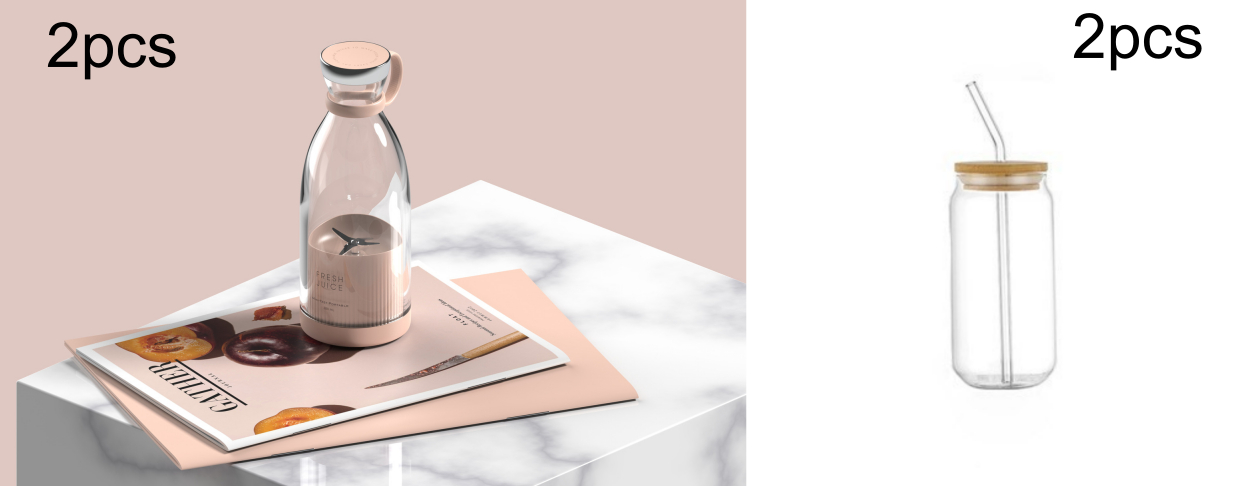

Photos from current listings. Actual item, color, and included accessories may vary.
Portable Rechargeable Juicer Buying Guide
A portable rechargeable juicer is a battery-powered, USB-charged masticating or centrifugal extractor designed for single-serve juice away from mains power. The core trade-off is motor torque and battery capacity versus cup size and portability: high-torque slow augers extract more from leafy greens but weigh more, while compact centrifugal units handle fruit fast but oxidize and foam. The decision rule is simple: choose a slow masticating model with a ≥2000mAh battery and a 12V/2A USB-C input for daily produce, and only choose a compact centrifugal unit for occasional soft-fruit juicing.
Key takeaways
- Motor architecture separates tiers: slow masticating augers run at 50–80 RPM for leafy greens and wheatgrass, while centrifugal blades spin at 15,000+ RPM and only juice soft produce.
- Battery capacity determines real yield: 2000mAh (~7.4V) delivers roughly 8–12 oz per charge, while 4000mAh dual-cell units deliver 20–30 oz before needing a 3–4 hour recharge.
- USB-C PD input at 12V/2A or higher charges in 2–3 hours; micro-USB or 5V/1A inputs take 6–8 hours and are the clearest sign of a dated or low-grade unit.
At a glance
- Category
- Blenders & Juicers
- Last updated
- Nov 29, 2026
Current offers
Highlights
- Motor architecture separates tiers: slow masticating augers run at 50–80 RPM for leafy greens and wheatgrass, while centrifugal blades spin at 15,000+ RPM and only juice soft produce.
- Battery capacity determines real yield: 2000mAh (~7.4V) delivers roughly 8–12 oz per charge, while 4000mAh dual-cell units deliver 20–30 oz before needing a 3–4 hour recharge.
- USB-C PD input at 12V/2A or higher charges in 2–3 hours; micro-USB or 5V/1A inputs take 6–8 hours and are the clearest sign of a dated or low-grade unit.
- Cup and auger materials matter: Tritan or BPA-free AS cups resist cracking and staining, while food-grade 304 stainless steel augers and screens outlast coated or plastic extraction parts.
Best use cases
- Best fit: daily green-juice drinkers should pick a slow masticating model with a 4000mAh battery, 304 stainless auger, and 12V/2A USB-C input; skip compact centrifugal units, which foam and oxidize leafy greens.
- Best fit: office and travel users should choose a 2000–3000mAh unit under 1.5 lb with a sealed 12–16 oz cup; skip high-torque auger models that exceed 2 lb and need two hands to assemble.
- Best fit: gym and soft-fruit users can use a compact centrifugal unit with a 3000mAh battery for oranges, berries, and melon; skip it for celery, kale, and wheatgrass, which clog the blade basket.
- Wrong fit: household batch juicing should skip all portable units and use a countertop 1000W+ masticating juicer; portable batteries cannot sustain continuous runs beyond 10–15 minutes.
Buying tips
- Match battery mAh to your yield: 2000mAh yields about 8–12 oz per charge, 4000mAh yields 20–30 oz, so buy dual-cell only if you juice daily without access to power.
- Require 12V/2A (24W) or higher USB-C PD input; 5V/1A micro-USB charging takes 6–8 hours and signals an older, lower-torque generation.
- For leafy greens and wheatgrass, choose a slow auger at 50–80 RPM with a 304 stainless screen; centrifugal blades at 15,000+ RPM are for citrus and soft fruit only.
- Check cup material: Tritan or BPA-free AS resists cracking and staining; avoid unmarked polycarbonate cups that cloud and crack under citrus acid.
Specs
| Extraction Type | Slow masticating 50–80 RPM vs centrifugal 15k RPM |
|---|---|
| Battery Capacity | 2000mAh (8–12 oz) vs 4000mAh (20–30 oz) |
| Charging Input | USB-C PD 12V/2A vs micro-USB 5V/1A |
| Cup/Auger Material | Tritan cup + 304 stainless auger |
Related searches
What to check before buying
- Measure your bag or cup-holder space: most portable juicers are 8–11 inches tall and 3–4 inches wide; confirm the assembled height fits before buying.
- Confirm your power source delivers USB-C PD at 12V/2A or higher; a 5V/1A wall adapter will not charge dual-cell units in a usable time.
- Check that the cup, auger, and screen are fully dishwasher-safe or hand-wash only; sealed motor bases cannot be submerged.
- Verify the unit includes a reverse function and a pulp container or dual-cup design; single-cup models require manual pulp straining.
FAQ
Data sources: eBay / Amazon listings and product attribute feeds. Updated Nov 29, 2026.
Some links on this page are affiliate links. If you buy after clicking one, we may earn a commission at no extra cost to you. This does not change which products appear here or their order. Affiliate disclosure.