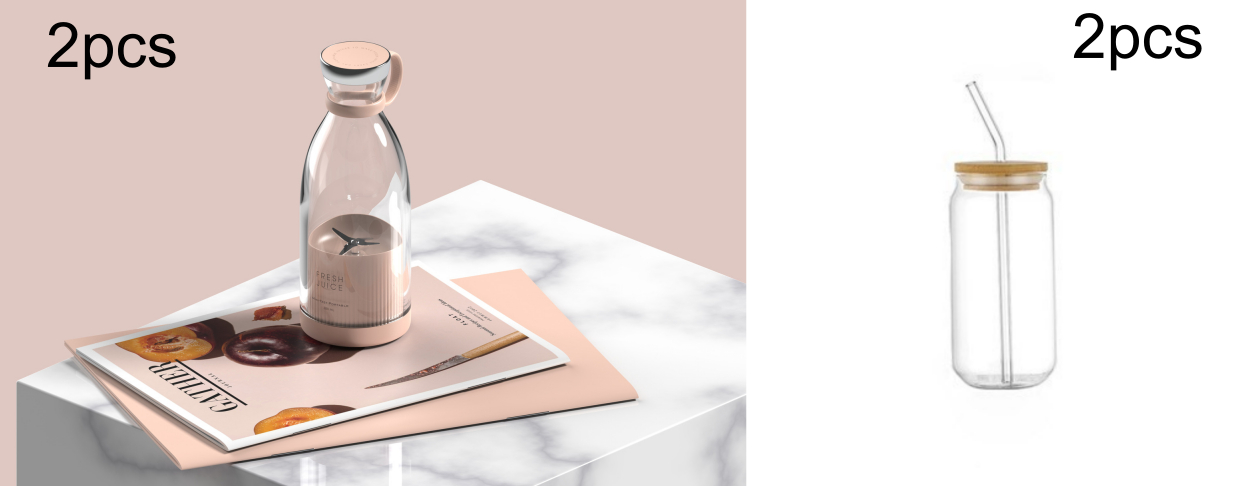

Photos from current listings. Actual item, color, and included accessories may vary.
Rechargeable Portable Blender Buying Guide
A rechargeable portable blender is a cordless, battery-powered blending cup designed for single-serve smoothies and shakes away from mains power. The core trade-off is motor torque and blade geometry versus battery capacity and jar sealing: low-power units (under 200W equivalent) stall on frozen fruit and ice, while higher-torque brushless models demand larger cells and add weight. The decision rule: buy only if the jar is leak-rated for inverted blending and the motor is rated for frozen loads; otherwise choose a corded personal blender.
Key takeaways
- Motor architecture splits into brushed DC (cheaper, shorter life, stalls on ice) and brushless DC (higher torque-per-watt, longer runtime, better frozen-fruit performance).
- Battery tier is defined by cell capacity in mAh and voltage: 2-cell 7.4V packs deliver roughly double the torque of 1-cell 3.7V packs at the same wattage rating.
- Jar material matters: Tritan copolyester resists cracking and odor; AS styrene and PP jars scratch and retain smells after repeated acidic blends.
At a glance
- Category
- Blenders & Juicers
- Last updated
- Nov 29, 2026
Current offers
Highlights
- Motor architecture splits into brushed DC (cheaper, shorter life, stalls on ice) and brushless DC (higher torque-per-watt, longer runtime, better frozen-fruit performance).
- Battery tier is defined by cell capacity in mAh and voltage: 2-cell 7.4V packs deliver roughly double the torque of 1-cell 3.7V packs at the same wattage rating.
- Jar material matters: Tritan copolyester resists cracking and odor; AS styrene and PP jars scratch and retain smells after repeated acidic blends.
- Blade count and geometry: 4–6 offset stainless blades create a vortex; 2-blade flat designs leave frozen chunks and require pre-cutting fruit.
Best use cases
- Best fit: office or gym commuter blending protein shakes and soft fruit — pick a 2-cell 7.4V brushless model with a 400–500ml Tritan jar and USB-C charging.
- Best fit: travel and hotel use with no ice — a 1-cell 3.7V brushed unit at 175–250ml is enough for powders and banana; skip frozen-fruit claims.
- Wrong fit: daily frozen-berry smoothies or ice crushing — no portable unit matches a corded 600W+ personal blender; choose corded instead.
- Wrong fit: family batches over 600ml — portable jars cap near 500ml usable; a corded full-size pitcher is the correct tool.
Buying tips
- Require a 2-cell 7.4V pack (or explicitly stated high-torque brushless motor) if you blend frozen fruit; 1-cell 3.7V units stall under load.
- Choose Tritan or glass jars over PP/AS; Tritan survives drops and hot rinses without odor transfer.
- Confirm USB-C PD input rather than micro-USB; PD allows faster recharge and fewer cable failures.
- Check blade count and offset: 4–6 staggered stainless blades blend frozen fruit; 2-blade flat designs need pre-cut soft fruit only.
Specs
| Motor Type | Brushless DC vs Brushed DC |
|---|---|
| Battery Pack | 2-cell 7.4V vs 1-cell 3.7V |
| Jar Material | Tritan / Glass / PP / AS |
| Charging Port | USB-C PD vs Micro-USB |
Related searches
What to check before buying
- Measure your cup holder and bag pocket: most units are 8–10cm diameter and 20–24cm tall with the jar attached.
- Confirm your outlet standard: USB-C PD chargers are universal; barrel-plug models ship region-specific adapters.
- Verify the jar seal is rated for inverted blending if you plan to flip the unit; leak-prone lids are the top failure mode.
- Check whether the blade assembly is removable for cleaning; fixed blades require water-and-soap self-clean cycles.
FAQ
Data sources: eBay / Amazon listings and product attribute feeds. Updated Nov 29, 2026.
Some links on this page are affiliate links. If you buy after clicking one, we may earn a commission at no extra cost to you. This does not change which products appear here or their order. Affiliate disclosure.