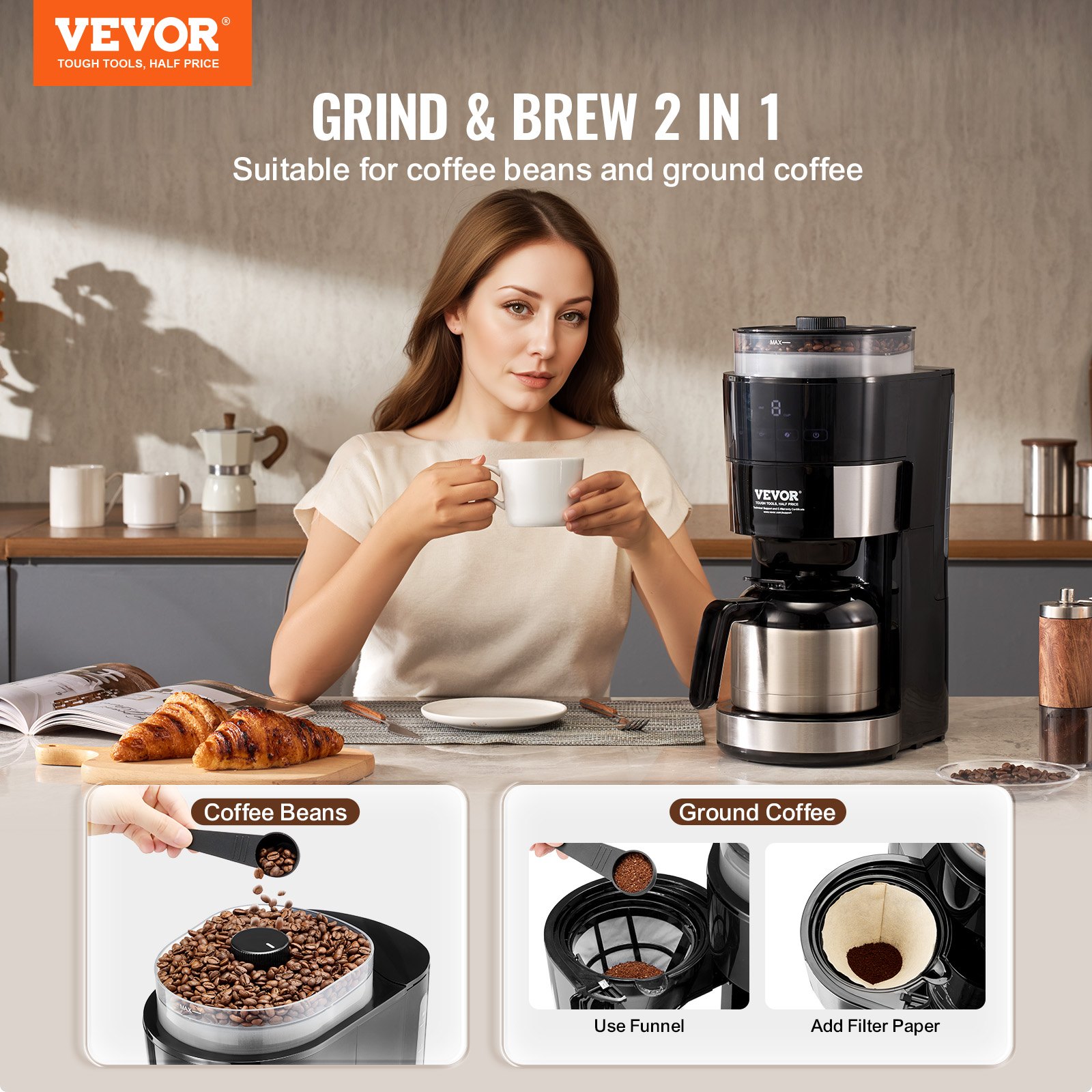

Photos from current listings. Actual item, color, and included accessories may vary.
Drip Coffee Maker With Grinder Buying Guide
A drip coffee maker with grinder combines a conical burr or blade grinder with a filter-basket brewer so beans are ground immediately before brewing, preserving volatile aromatics that pre-ground coffee loses within minutes. The core trade-off is grinder architecture versus brewer temperature control: cheap blade grinders produce inconsistent particle sizes that cause channeling and bitter over-extraction, while a conical burr grinder paired with a 195-205°F brew cycle delivers café-grade extraction. The decision rule is simple: buy only if the grinder is burr-based and the brewer reaches at least 195°F; skip any unit where the grinder is a blade mill or the brew temperature is uncontrolled.
Median $159.99
Key takeaways
- Conical burr grinders produce uniform particle size critical for even extraction; blade grinders chop inconsistently and create fines that clog filters and cause bitterness.
- SCA-certified brewers maintain 195-205°F water temperature and 4-5 minute contact time; uncertified drip machines often brew at 170-185°F, yielding sour, under-extracted coffee.
- 12-cup carafe models brew 60 oz; 8-cup models brew 40 oz — match carafe size to household consumption since brewed coffee degrades after 30-60 minutes on a warming plate.
At a glance
- Category
- Coffee Makers & Espresso
- Last updated
- Nov 28, 2026
Current offers
Highlights
- Conical burr grinders produce uniform particle size critical for even extraction; blade grinders chop inconsistently and create fines that clog filters and cause bitterness.
- SCA-certified brewers maintain 195-205°F water temperature and 4-5 minute contact time; uncertified drip machines often brew at 170-185°F, yielding sour, under-extracted coffee.
- 12-cup carafe models brew 60 oz; 8-cup models brew 40 oz — match carafe size to household consumption since brewed coffee degrades after 30-60 minutes on a warming plate.
- Programmable 24-hour timers and 4-hour keep-warm plates are convenience features, but glass carafes on exposed hot plates scorch coffee after 20 minutes; thermal carafes preserve flavor without heat.
Best use cases
- Best fit: daily home brewers drinking 2-4 cups who want fresh-ground flavor with minimal effort — choose a burr-grinder drip model with 8-12 cup capacity and programmable timer.
- Wrong fit: espresso or pour-over enthusiasts needing fine, adjustable grind — a combo drip unit's grinder lacks the stepless adjustment and fine range for espresso; buy a standalone burr grinder instead.
- Best fit: small households or singles — pick an 8-cup model with 3 brew-strength settings and a thermal carafe to avoid waste and scorching.
- Wrong fit: large families or office settings needing more than 12 cups — combo units max out at 12 cups; step up to a commercial batch brewer with separate grinder.
Buying tips
- Insist on a conical burr grinder (steel or ceramic) rated for drip-to-medium grind; blade grinders are unacceptable for repeatable extraction regardless of brewer quality.
- Verify SCA certification or a stated brew temperature range of 195-205°F — this single spec separates true specialty brewers from commodity drip machines.
- Match carafe capacity to daily consumption: 8-cup (40 oz) for 1-2 people, 12-cup (60 oz) for 3-4 people; oversized carafes waste coffee and degrade on hold.
- Choose a thermal carafe over a glass carafe with hot plate if you won't drink the pot within 20 minutes — hot plates scorch coffee and destroy delicate aromatics.
Specs
| Grinder Type | Conical burr vs blade |
|---|---|
| Brew Temperature | 195-205°F (SCA) vs uncontrolled |
| Carafe Capacity | 8-cup (40 oz) / 12-cup (60 oz) |
| Carafe Type | Thermal vs glass with hot plate |
Related searches
What to check before buying
- Measure your counter depth and height clearance: combo units typically run 10-14 inches wide and 14-16 inches tall — confirm space under upper cabinets and clearance for the bean hopper lid.
- Confirm your electrical outlet delivers standard 120V/60Hz (US) or 220-240V (EU) and that the machine's plug matches your kitchen circuit; avoid adapters on high-wattage brewers.
- Check filter availability: most combo units use #4 cone or basket filters — verify standard supermarket filters fit, or budget for reusable gold-tone filters.
- Plan for grinder maintenance: whole-bean hoppers need monthly cleaning to prevent oil buildup; confirm the grinder chamber is removable or accessible for brushing.
FAQ
Data sources: eBay / Amazon listings and product attribute feeds. Updated Nov 28, 2026.
Some links on this page are affiliate links. If you buy after clicking one, we may earn a commission at no extra cost to you. This does not change which products appear here or their order. Affiliate disclosure.