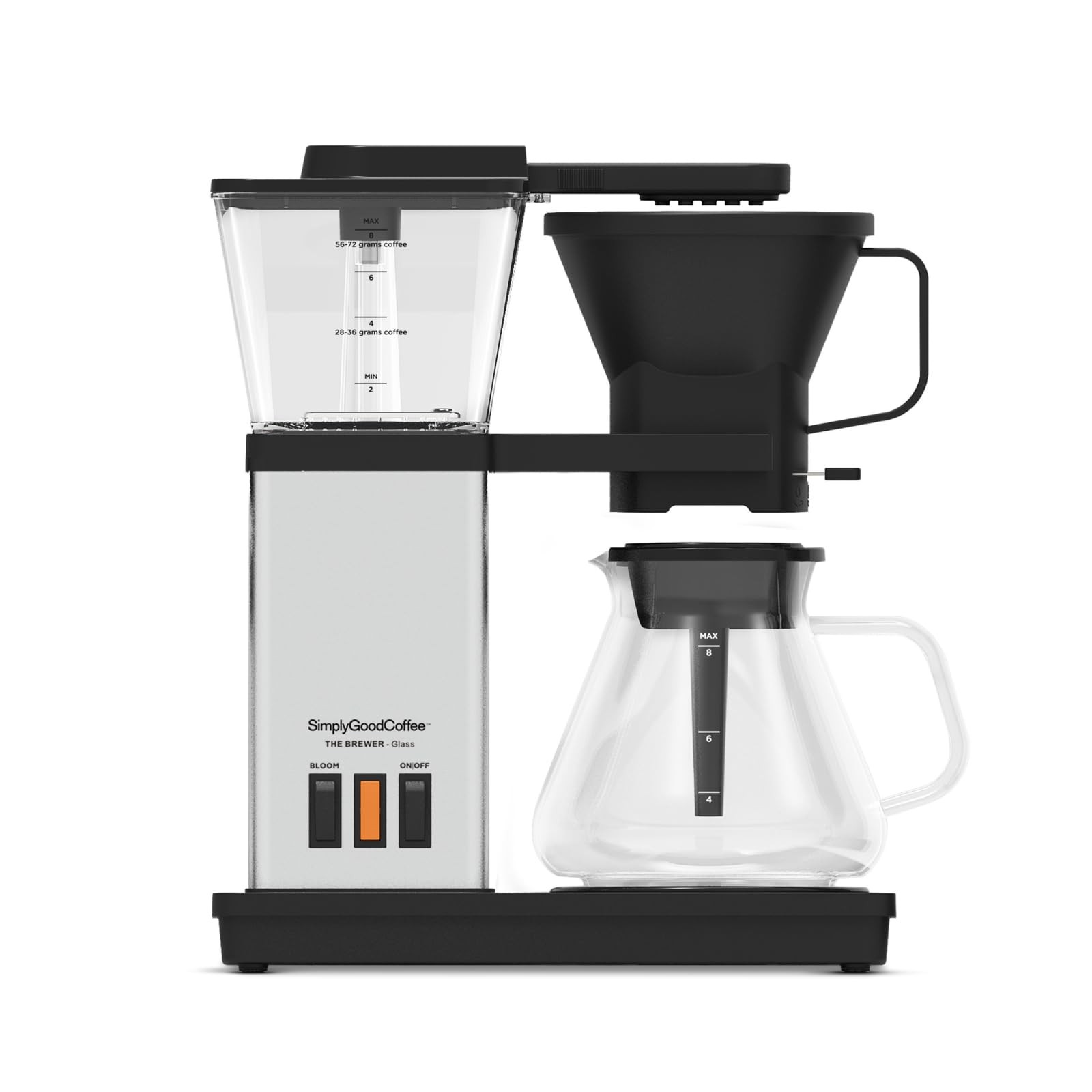

Photos from current listings. Actual item, color, and included accessories may vary.
Pour Over Coffee Maker Buying Guide
Pour over coffee makers are manual or automatic brewers that drip water through a coffee bed in a filter, delivering clarity and control that immersion brewers can't match. The core trade-off is between manual cones (cheap, technique-dependent, plastic vs glass vs ceramic) and automatic pour-over machines (consistent temperature and pulse pouring at a higher price). Choose manual if you want control and low cost; choose automatic if repeatability matters more than ritual.
Key takeaways
- Manual cones fall into three material tiers: plastic (cheap, retains heat poorly, can crack), glass (neutral flavor, fragile), and ceramic (thermal mass stabilizes brew temp but needs preheating)
- Automatic pour-over machines use pulse or spiral dispensing to mimic hand pouring; cheap models often lack precise temperature control (target 195–205°F) and use showerheads with uneven saturation
- Filter style defines cup profile: cone-shaped paper filters (V60-style) brew faster with more clarity; flat-bottom filters (Kalita-style) give more even extraction and body
At a glance
- Category
- Coffee Makers & Espresso
- Last updated
- Nov 28, 2026
Current offers
Highlights
- Manual cones fall into three material tiers: plastic (cheap, retains heat poorly, can crack), glass (neutral flavor, fragile), and ceramic (thermal mass stabilizes brew temp but needs preheating)
- Automatic pour-over machines use pulse or spiral dispensing to mimic hand pouring; cheap models often lack precise temperature control (target 195–205°F) and use showerheads with uneven saturation
- Filter style defines cup profile: cone-shaped paper filters (V60-style) brew faster with more clarity; flat-bottom filters (Kalita-style) give more even extraction and body
- Brewer capacity is rated in cups (typically 4–8 oz each); a 2-cup cone suits one mug, while 8-cup automatic models suit households but often brew weaker at full capacity
Best use cases
- Best fit: solo daily drinker who wants one mug and full control — pick a 1–2 cup ceramic or glass cone with #2 paper filters and a gooseneck kettle
- Best fit: household of 3+ or office setting where nobody wants to hand-pour — pick an 8-cup automatic pour-over machine with programmable timer and thermal carafe
- Wrong fit: buying a cheap automatic drip machine labeled 'pour over' — most are standard drip brewers with a showerhead, not true pulse-pour over; skip unless it specifies pulse or intermittent dispensing
- Wrong fit: expecting espresso-strength coffee from any pour-over brewer — pour over makes filter coffee, not espresso; skip if you want concentrated shots
Buying tips
- Match cone size to batch: #1 filters fit 1–2 cup cones, #2 filters fit 2–4 cup cones, #4 filters fit 8–10 cup batch brewers — buying the wrong size causes overflow or weak coffee
- For automatic models, confirm brew temperature reaches 195–205°F; models without a specified temperature often brew below 190°F and produce sour, under-extracted coffee
- Choose a thermal carafe over a hot plate: hot plates scorch coffee after 20 minutes, while double-wall stainless carafes hold temperature for hours without cooking the brew
- For manual brewing, budget for a gooseneck kettle with variable temperature control — a standard kettle pours too fast and floods the coffee bed, ruining extraction
Specs
| Brew Method | Manual cone / Automatic pulse |
|---|---|
| Material | Plastic / Glass / Ceramic / Steel |
| Filter Type | #1-#4 cone / Flat-bottom |
| Capacity | 1-2 cups / 4-8 cups batch |
Related searches
What to check before buying
- Measure your mug and counter space: a 2-cup cone needs about 5 inches of clearance; 8-cup automatic machines need 10–12 inches of height and a nearby outlet
- Check filter availability: standard #2 and #4 cone filters are sold everywhere; unusual cone shapes may require proprietary filters that are harder to find
- Confirm voltage and plug standard matches your country (120V US vs 230V EU) for automatic models; manual cones have no electrical requirement
- For automatic machines, verify carafe capacity matches your daily consumption — brewing less than full capacity in a large machine often causes temperature and extraction inconsistencies
FAQ
Data sources: eBay / Amazon listings and product attribute feeds. Updated Nov 28, 2026.
Some links on this page are affiliate links. If you buy after clicking one, we may earn a commission at no extra cost to you. This does not change which products appear here or their order. Affiliate disclosure.