
Photos from current listings. Actual item, color, and included accessories may vary.
Glass Electric Tea Kettle Buying Guide
Glass electric tea kettles pair a transparent borosilicate body with a concealed heating element, so you can watch the water boil while avoiding plastic contact with hot water. The core trade-off is thermal shock resistance and base-plate quality: cheap soda-lime glass and thin stamped elements crack or scale, while true borosilicate bodies with a full stainless-steel heating plate last for years. The decision rule: buy only borosilicate glass, a 304 stainless-steel concealed element, and a cordless 360° base with auto shut-off and boil-dry protection; skip any kettle with exposed plastic in the water chamber or a non-removable lid.
Median $344.22 · New listings
Key takeaways
- Borosilicate glass (typically 3.3 coefficient of expansion) withstands rapid temperature swings; soda-lime glass is cheaper but prone to thermal-shock cracking at the base seam.
- Concealed 304 stainless-steel heating plates resist limescale buildup and corrosion; exposed coil or aluminum plates pit and impart metallic taste.
- Strix or equivalent thermostat controls deliver accurate boil cut-off and boil-dry protection; generic bimetal switches drift and fail to shut off.
At a glance
- Category
- Electric Kettles
- Last updated
- Nov 28, 2026
Current offers
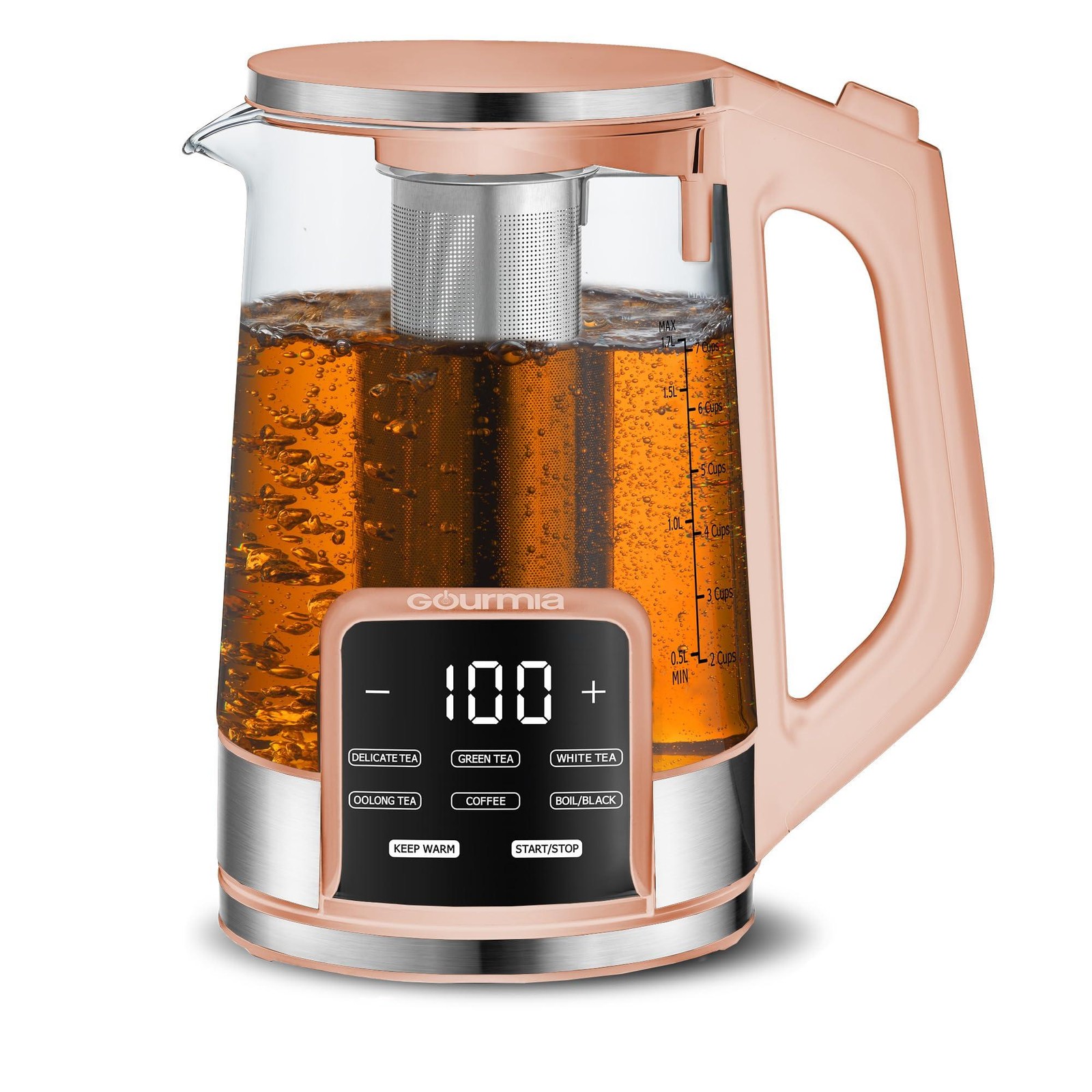 Gourmia Electric Glass Kettle – 1.7L Programmable Tea & Coffee Brewer with Digit$344.22New · Last checked Nov 26, 2026View on eBay
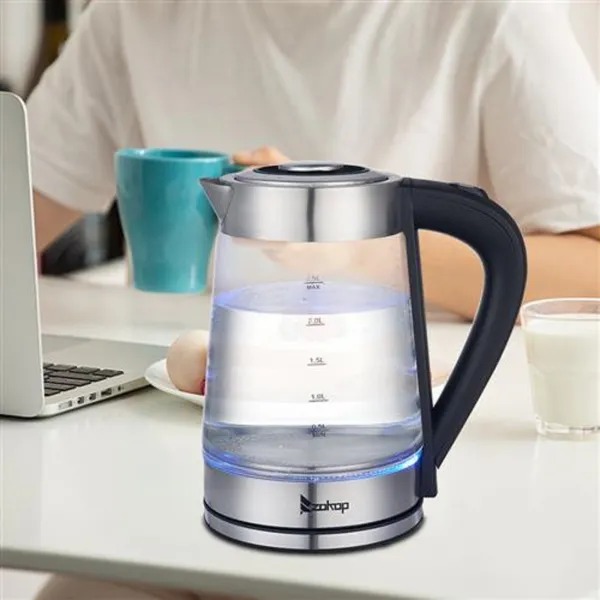 HD-250 110V 1200W 2.5L Electric Kettle With Blue Glass$30.99View on Mallflare
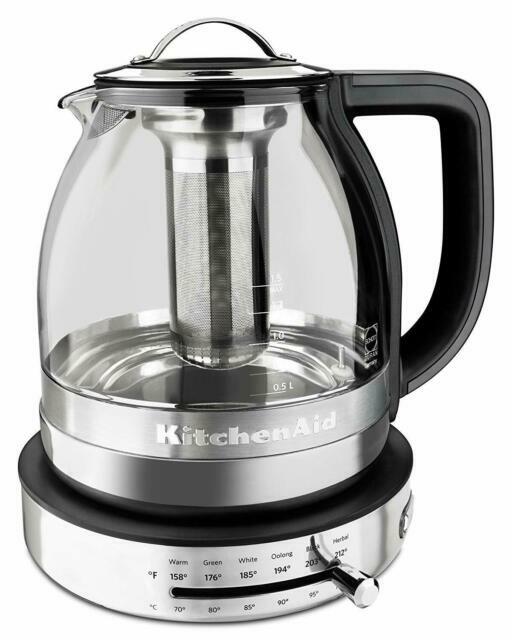 KitchenAid KEK1322SS 1.5L Electric Glass Tea Kettle - Stainless Steel$349.99New · Last checked Nov 16, 2026View on eBay
Highlights
- Borosilicate glass (typically 3.3 coefficient of expansion) withstands rapid temperature swings; soda-lime glass is cheaper but prone to thermal-shock cracking at the base seam.
- Concealed 304 stainless-steel heating plates resist limescale buildup and corrosion; exposed coil or aluminum plates pit and impart metallic taste.
- Strix or equivalent thermostat controls deliver accurate boil cut-off and boil-dry protection; generic bimetal switches drift and fail to shut off.
- Cordless 360° swivel bases with flat, wide contacts are standard on quality units; narrow pin contacts on budget models arc and wear.
Best use cases
- Buy a 1.7 L borosilicate kettle with a concealed 304 plate if you boil water several times daily for tea and pour-over coffee; skip 1.0 L mini kettles that need refilling mid-brew.
- Choose a variable-temperature glass kettle (140–212°F presets) for green and white tea; skip fixed-boil models that scorch delicate leaves.
- Pick a glass kettle with a removable stainless infuser and keep-warm function for loose-leaf brewing at the desk; skip it if you only need rapid boiling for cooking.
- Skip glass entirely if the kettle lives in a high-traffic kitchen with hard knocks or if you routinely boil and immediately rinse under cold water—stainless double-wall is more forgiving.
Buying tips
- Match capacity to cups: 1.0 L fills about four 8 oz cups; 1.7 L fills six to seven. Choose 1.7 L for households of two or more.
- Confirm the glass is labeled borosilicate or heat-resistant to at least 300°F; unlabeled clear glass on budget listings is usually soda-lime.
- Look for a concealed flat 304 stainless plate under the glass floor—visible spiral coils and aluminum plates scale faster and are harder to descale.
- Require auto shut-off, boil-dry protection, and a cordless 360° base; these are the minimum safety electronics on any credible glass kettle.
Specs
| Glass Type | Borosilicate vs soda-lime |
|---|---|
| Heating Plate | Concealed 304 stainless vs exposed coil |
| Capacity | 1.0 L vs 1.7 L |
| Safety Electronics | Auto shut-off + boil-dry protection |
Related searches
What to check before buying
- Measure your counter clearance and cabinet overhang: a 1.7 L glass kettle stands roughly 9–11 inches tall with the handle, so allow headroom to lift the lid.
- Check your outlet voltage and plug standard (120 V NEMA 1-15 in North America, 230 V Type G/F elsewhere); glass kettles are region-specific and not dual-voltage.
- Verify your water hardness: above roughly 180 mg/L calcium carbonate, plan on weekly descaling with citric acid to keep the glass clear and the plate efficient.
- Confirm the base footprint fits your counter and that the cord length reaches your outlet without an extension cord over the sink area.
FAQ
Data sources: eBay / Amazon listings and product attribute feeds. Updated Nov 28, 2026.
Some links on this page are affiliate links. If you buy after clicking one, we may earn a commission at no extra cost to you. This does not change which products appear here or their order. Affiliate disclosure.