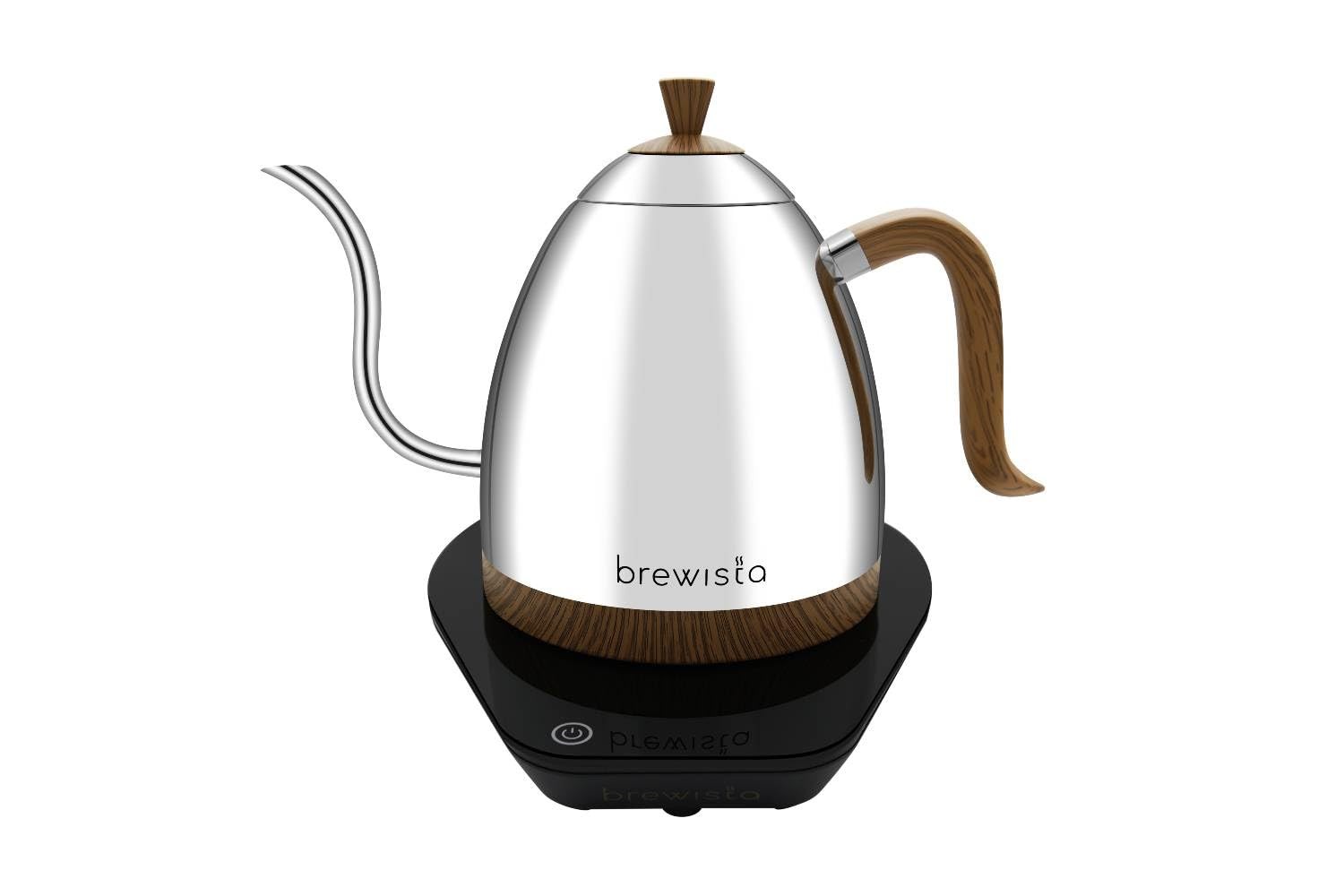

Photos from current listings. Actual item, color, and included accessories may vary.
Temp Control Electric Kettle Buying Guide
Temp control electric kettles use a thermistor and PID-style controller to hold water at a setpoint within ±1–5°F, unlike bimetal kettles that only boil and shut off. The core trade-off is sensor accuracy and heating-element stability versus body insulation and pour control. Choose a model with a digital setpoint in 1–5°F increments and a hold function; skip any kettle that offers only fixed presets without a manual temperature dial.
Key takeaways
- PID controllers with a thermistor at the base hold ±1–2°F; cheaper thermostats swing ±5–10°F, which matters for green tea at 160°F versus French press at 200°F.
- Gooseneck spouts restrict flow to roughly 0.5–1.0 GPM for pour-over control; wide spouts deliver 2–3 GPM and are better for filling pots and French presses.
- Double-wall vacuum insulation keeps water within 5°F for 30–60 minutes and lowers exterior temperature below 120°F; single-wall stainless reaches 200°F+ on the body.
At a glance
- Category
- Electric Kettles
- Last updated
- Nov 28, 2026
Current offers
Highlights
- PID controllers with a thermistor at the base hold ±1–2°F; cheaper thermostats swing ±5–10°F, which matters for green tea at 160°F versus French press at 200°F.
- Gooseneck spouts restrict flow to roughly 0.5–1.0 GPM for pour-over control; wide spouts deliver 2–3 GPM and are better for filling pots and French presses.
- Double-wall vacuum insulation keeps water within 5°F for 30–60 minutes and lowers exterior temperature below 120°F; single-wall stainless reaches 200°F+ on the body.
- 120V/1500W elements bring 1L to boil in 4–6 minutes; 1000W or lower elements push that past 8 minutes and struggle to recover after a pour.
Best use cases
- Pour-over coffee: pick a 0.8–1.0L gooseneck with 1°F setpoint steps and a 60-minute hold; skip wide-spout kettles that surge past 1.0 GPM.
- Tea brewing across green, oolong, and black: choose presets at 160/175/195/212°F plus a manual dial; skip kettles limited to a single boil setting.
- French press or instant noodles: a 1.5–1.7L wide-spout model at 1500W boils faster and pours volume; skip 0.6L goosenecks that need refilling.
- Small kitchens or dorms: a 0.6–0.8L single-wall model saves counter space; skip it if you need 30-minute hold or cool-touch exteriors.
Buying tips
- Match capacity to cups per session: 0.6L fills about two 10 oz cups, 1.0L fills three to four, and 1.7L fills six or more before refilling.
- Confirm the setpoint range covers 104–212°F with 5°F or finer steps; a 1°F display is only useful if the sensor holds within 2°F.
- Check the spout: gooseneck at 6–8mm inner diameter for pour-over; wide 20mm+ spouts for volume filling and immersion brewing.
- Prefer 304 food-grade stainless or borosilicate glass interiors; plastic-kettle liners can impart taste and are harder to descale.
Specs
| Temperature Accuracy | ±1–2°F PID vs ±5–10°F thermostat |
|---|---|
| Capacity Range | 0.6L gooseneck to 1.7L wide-spout |
| Spout Type | Gooseneck 0.5–1.0 GPM / Wide 2–3 GPM |
| Body Insulation | Double-wall vacuum vs single-wall |
Related searches
What to check before buying
- Measure your counter and upper-cabinet clearance: most 1L goosenecks stand 9–12 inches tall with the handle, and the lid needs 4–6 inches to open.
- Verify a 120V grounded outlet within cord reach (typically 2–3 feet); 1500W kettles draw 12.5A and should not share a circuit with a microwave.
- Check your filter or water hardness: scale buildup degrades thermistor accuracy, so plan on descaling every 2–4 weeks in hard-water areas.
- Confirm the base footprint (6–8 inches) fits your counter and that the kettle lifts off the base for cordless pouring and washing.
FAQ
Data sources: eBay / Amazon listings and product attribute feeds. Updated Nov 28, 2026.
Some links on this page are affiliate links. If you buy after clicking one, we may earn a commission at no extra cost to you. This does not change which products appear here or their order. Affiliate disclosure.