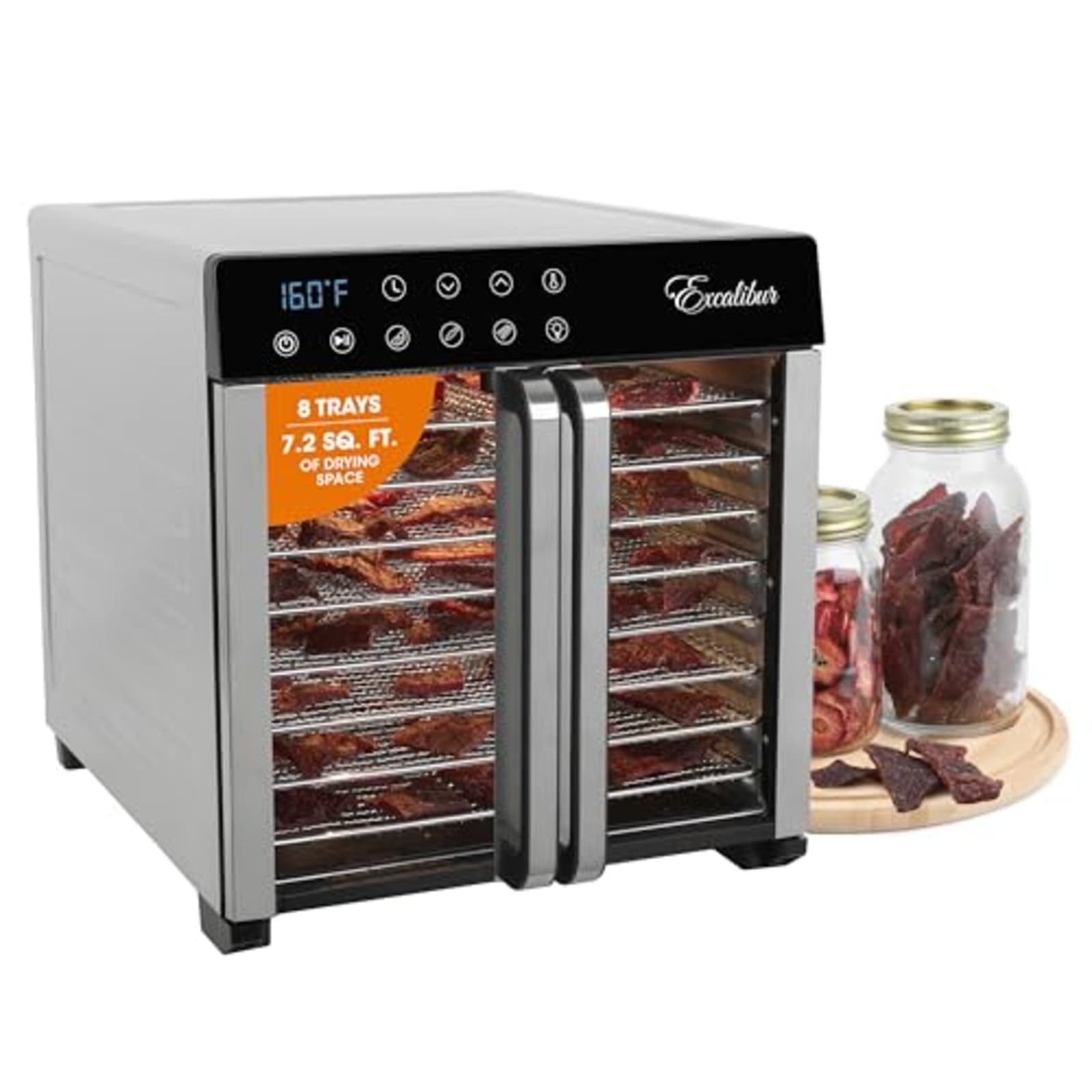

Photos from current listings. Actual item, color, and included accessories may vary.
Excalibur Food Dehydrator Buying Guide
Excalibur food dehydrators are the reference standard for home and semi-pro dehydration, defined by their horizontal airflow, stackable tray architecture, and modular temperature control. The core trade-off is tray count and control tier: 4-5 tray base models use simple dial thermostats, while 9-tray Select and Performance series add digital presets, stainless construction, and higher wattage for faster, more even drying. Buy the largest tray count and controller tier your counter and batch size justify—anything smaller or analog-only is a compromise for heavy use.
Key takeaways
- Horizontal Parallex airflow blows heated air across every tray evenly, eliminating the front-to-back drying gradient common in vertical-flow round dehydrators.
- Select Series uses stainless steel trays and French doors; Performance Series adds digital temperature presets and a 99-hour timer over the base dial-only models.
- Tray count scales batch capacity: 4-tray models handle small herb and jerky runs, 5-tray fits standard counter depth, and 9-tray units process full harvests in one load.
At a glance
- Category
- Food Dehydrators
- Last updated
- Nov 28, 2026
Current offers
Highlights
- Horizontal Parallex airflow blows heated air across every tray evenly, eliminating the front-to-back drying gradient common in vertical-flow round dehydrators.
- Select Series uses stainless steel trays and French doors; Performance Series adds digital temperature presets and a 99-hour timer over the base dial-only models.
- Tray count scales batch capacity: 4-tray models handle small herb and jerky runs, 5-tray fits standard counter depth, and 9-tray units process full harvests in one load.
- Wattage rises with tray count—base 4-5 tray units draw roughly 440-620W, while 9-tray Performance models run near 600-700W for faster recovery between loaded trays.
Best use cases
- Pick a 9-tray Select or Performance model if you dry full garden harvests, large jerky batches, or fruit leather in volume—the tray area and digital timer are worth the counter footprint.
- Choose a 5-tray base dial model for occasional jerky, herbs, and dried fruit for one or two people; skip the 9-tray tier if you dry less than a few pounds per session.
- Skip Excalibur entirely for raw vegan low-temp work below 95°F unless you confirm the model's adjustable thermostat reaches that low; base dial units bottom out higher than dedicated low-temp dehydrators.
- Pick stainless Select Series over plastic-tray base models if you routinely dry acidic foods, marinated jerky, or run long multi-day cycles where tray staining and odor retention matter.
Buying tips
- Match tray count to batch weight: each Excalibur tray holds roughly 1-1.5 lb of fresh produce, so a 9-tray unit handles about 9-13 lb per load versus 4-6 lb for a 5-tray model.
- Prioritize digital thermostat and timer (Select/Performance) over dial-only base models—accurate 105-165°F control is the difference between safe jerky and case-hardened or overdried batches.
- Confirm counter depth before buying 9-tray units: they run roughly 19-20 inches deep and need rear clearance for the fan; 5-tray models fit standard 24-inch counters with room to spare.
- Choose stainless steel trays and French doors for longevity and easier cleaning; plastic tray models are lighter and cheaper but scratch and retain odors over years of jerky and onion drying.
Specs
| Airflow | Horizontal Parallex rear-fan |
|---|---|
| Tray Count | 4, 5, or 9 stackable trays |
| Control Tier | Analog dial vs digital preset |
| Tray Material | Plastic vs stainless steel |
Related searches
What to check before buying
- Measure counter depth and height clearance: 9-tray Excalibur units need about 20 inches depth plus rear fan clearance and roughly 12-14 inches height with trays stacked.
- Confirm a dedicated 120V grounded outlet near the counter—higher-wattage 9-tray models should not share a circuit with other high-draw appliances during long cycles.
- Check that your batch weight matches tray count: weigh your typical fresh load and divide by about 1-1.5 lb per tray to pick 4, 5, or 9 trays.
- Verify the model's thermostat range covers your recipes—jerky needs 145-165°F, herbs 95-115°F, and fruit leather 130-140°F; base dial models may not hit the low end precisely.
FAQ
Data sources: eBay / Amazon listings and product attribute feeds. Updated Nov 28, 2026.
Some links on this page are affiliate links. If you buy after clicking one, we may earn a commission at no extra cost to you. This does not change which products appear here or their order. Affiliate disclosure.