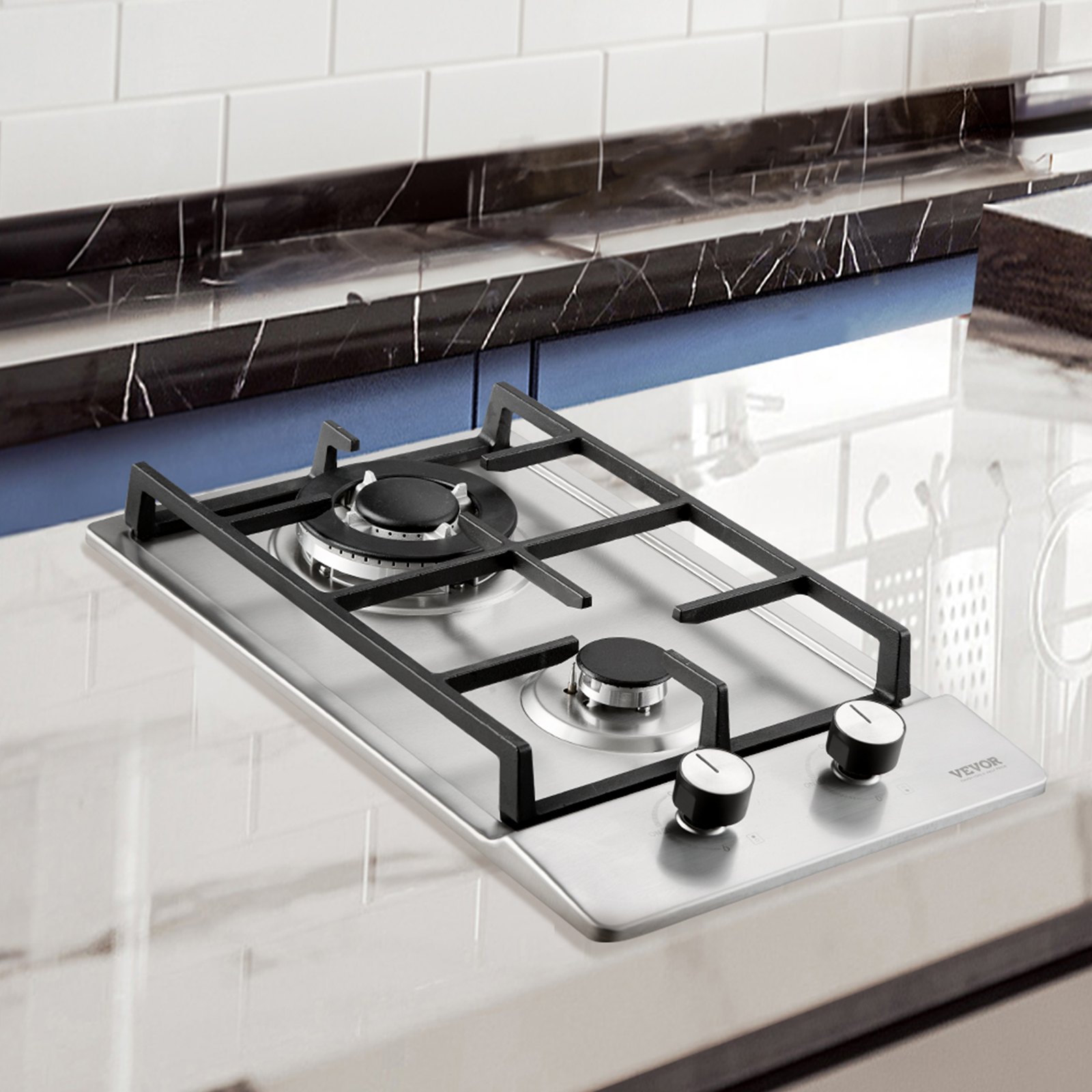

Photos from current listings. Actual item, color, and included accessories may vary.
2 Burner Gas Stove Buying Guide
A 2-burner gas stove is a compact, freestanding or drop-in cooking appliance in which two sealed gas burners feed a single stovetop, either as a standalone hotplate or the top half of a small range. The core trade-off is burner output and build grade versus footprint: entry units use thin stamped steel grates and low-BTU open burners, while durable units use cast-iron grates, sealed brass burners, and a thermocouple flame-failure safety device on every burner. The decision rule is simple: buy cast-iron grates plus a thermocouple cutoff if the stove runs daily or in a rental, and accept enamel-coated steel grates only for light, occasional use where the lowest weight and cost matter.
Key takeaways
- Burner output separates cooking capability into tiers: standard open burners run roughly 5,000-9,000 BTU each, while high-output sealed burners reach 12,000-18,000 BTU and need a matching regulator and hose.
- Grate material is the durability metric that matters: cast-iron grates hold heat and resist warping for years, whereas enameled steel grates chip and rust once the coating cracks.
- Flame-failure safety is a thermocouple or FFD (flame-failure device) on each burner that shuts the gas off when the flame goes out; it is legally required on many markets and is the single best safety indicator.
At a glance
- Category
- Home Ranges, Ovens & Cooktops
- Last updated
- Nov 28, 2026
Current offers
Highlights
- Burner output separates cooking capability into tiers: standard open burners run roughly 5,000-9,000 BTU each, while high-output sealed burners reach 12,000-18,000 BTU and need a matching regulator and hose.
- Grate material is the durability metric that matters: cast-iron grates hold heat and resist warping for years, whereas enameled steel grates chip and rust once the coating cracks.
- Flame-failure safety is a thermocouple or FFD (flame-failure device) on each burner that shuts the gas off when the flame goes out; it is legally required on many markets and is the single best safety indicator.
- Gas type and pressure define compatibility: LPG (propane) units run at roughly 2,800 Pa / 11 in. w.c. and natural-gas units at roughly 1,000-2,000 Pa, and each needs its own jet size, so convertible units ship with both jet sets.
Best use cases
- Best fit: a small apartment, studio, or ADU kitchen where a full 4-burner range will not physically fit — choose a 2-burner drop-in cooktop with sealed burners and cast-iron grates that matches the counter cutout.
- Best fit: a cabin, RV, or outdoor kitchen running on a propane cylinder — pick a freestanding 2-burner stove with an LPG jet set and a regulator rated for the cylinder pressure, not a natural-gas-only model.
- Wrong fit to skip: a household cooking full meals for four or more people — two burners cannot run a large pot and a side simultaneously, so step up to a 4-burner range.
- Wrong fit to skip: a rental or shared unit where safety compliance matters — avoid open-burner models with no thermocouple and no flame-failure device, since a flame-out will leak gas.
Buying tips
- Match the burner power to your cookware: a 2-burner stove needs at least one burner at 10,000 BTU or more for a wok or large stockpot, and one low-output simmer burner around 3,000-5,000 BTU for sauces.
- Measure the cutout, not the outer trim: a drop-in 2-burner cooktop requires a counter cutout roughly 11-12 in. deep by 19-21 in. wide, and the glass or stainless lip must overhang the cutout by at least 1 in. on every side.
- Choose sealed brass burners over open burners for daily use — sealed burners keep spills out of the gas path and are removable for cleaning, while open burners let liquid into the burner body and clog the jet.
- Confirm the gas family before ordering: LPG and natural gas are not interchangeable without swapping jets, and a unit that ships LPG-only will not run on household natural gas without the correct conversion kit.
Specs
| Burner Type | Sealed brass vs open burner |
|---|---|
| Grate Material | Cast iron vs enameled steel |
| Gas Type | LPG / natural gas (convertible) |
| Burner Output | 3,000-18,000 BTU per burner |
Related searches
What to check before buying
- Measure the counter cutout width and depth plus the clearance to the wall and the overhead cabinet — a 2-burner cooktop needs at least 2-3 in. of side clearance and a non-combustible back panel.
- Check the gas supply type and pressure at the wall: LPG cylinder versus natural-gas line, and confirm the unit ships with the matching jets and regulator.
- Verify the electrical requirement for ignition — battery-powered spark ignition needs no outlet, while plug-in ignition needs a nearby 120 V (US) or 220-240 V (EU/UK) socket.
- Check the grate footprint against your largest pan diameter: cast-iron grates should span at least 8-10 in. per burner so a 10-in. skillet sits flat without tipping.
FAQ
Data sources: eBay / Amazon listings and product attribute feeds. Updated Nov 28, 2026.
Some links on this page are affiliate links. If you buy after clicking one, we may earn a commission at no extra cost to you. This does not change which products appear here or their order. Affiliate disclosure.