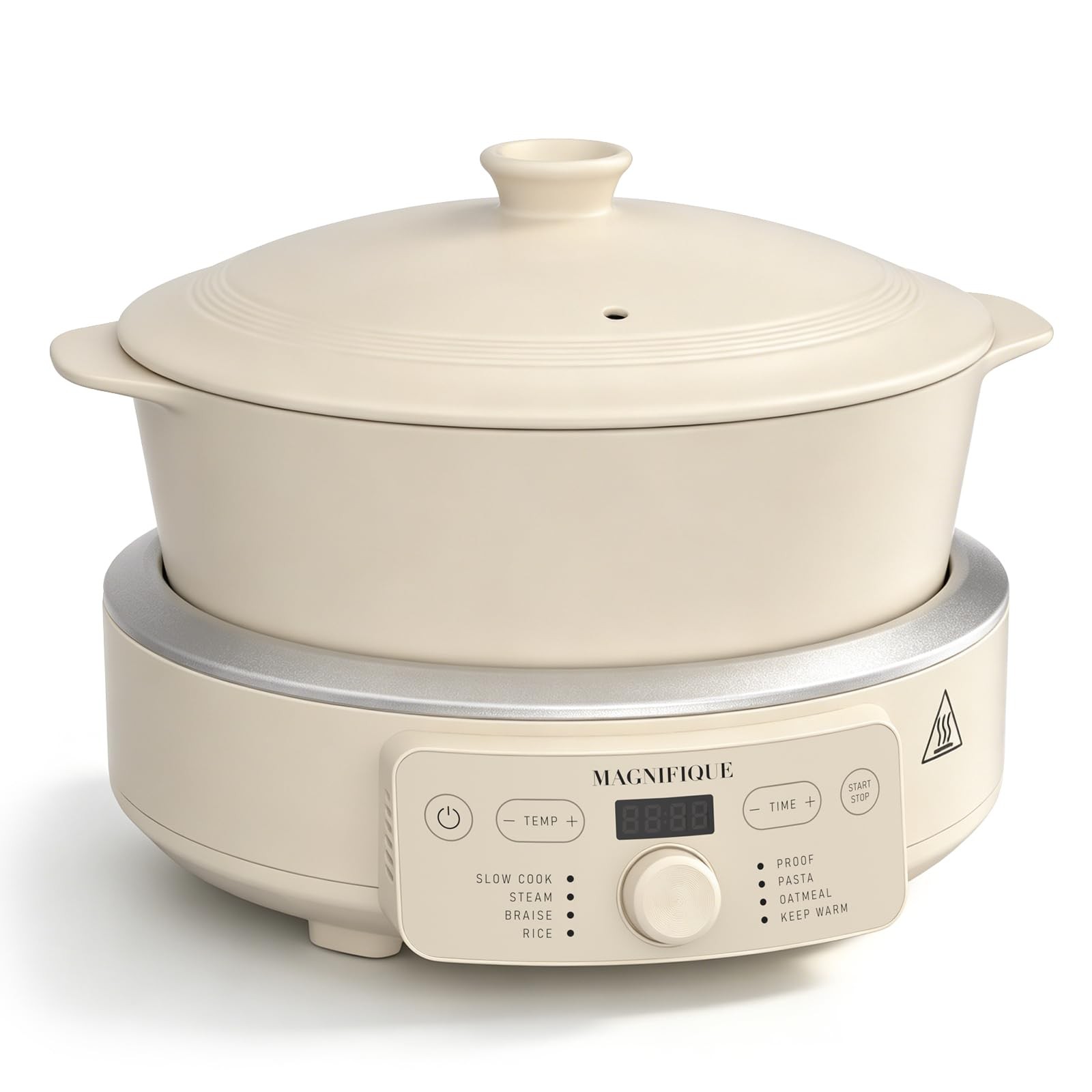

Photos from current listings. Actual item, color, and included accessories may vary.
Non Toxic Slow Cooker Buying Guide
A non-toxic slow cooker is a countertop appliance whose food-contact surfaces—crock, lid, and any nonstick coating—are free of lead, cadmium, PFAS, and other concerning substances, while still delivering the even, low-and-slow heat that makes slow cooking work. The core trade-off is between ceramic/glass and coated-metal construction: ceramic and glass are inert but heavy and thermal-shock sensitive, while nonstick aluminum is light and easy to clean but relies on coating integrity. The decision rule is simple: choose an unglazed or lead-free-glazed ceramic crock or a tempered-glass lid, avoid scratched nonstick interiors, and confirm independent third-party testing for food-contact materials rather than trusting marketing claims.
Key takeaways
- Ceramic crocks with lead-free, cadmium-free glazes tested to FDA or California Prop 65 limits are the benchmark for inert food contact; unglazed clay is also viable but requires seasoning.
- Tempered-glass lids with stainless-steel rims and silicone gaskets eliminate painted or coated undersides that can flake or leach; all-glass or glass-and-steel lids are safest.
- Nonstick interiors (PTFE/PFAS-based) are the main concern: once scratched, they can release particles and fumes; ceramic-coated nonstick is PFAS-free but still degrades with metal utensils.
At a glance
- Category
- Slow & Pressure Cookers
- Last updated
- Nov 28, 2026
Current offers
Highlights
- Ceramic crocks with lead-free, cadmium-free glazes tested to FDA or California Prop 65 limits are the benchmark for inert food contact; unglazed clay is also viable but requires seasoning.
- Tempered-glass lids with stainless-steel rims and silicone gaskets eliminate painted or coated undersides that can flake or leach; all-glass or glass-and-steel lids are safest.
- Nonstick interiors (PTFE/PFAS-based) are the main concern: once scratched, they can release particles and fumes; ceramic-coated nonstick is PFAS-free but still degrades with metal utensils.
- Stainless-steel and cast-aluminum housings with cool-touch handles and 3-wire grounded cords reduce heat and shock risks; a tight-fitting lid and 120V/60Hz US plug are baseline safety requirements.
Best use cases
- Best fit: a 6–8 qt ceramic-crock slow cooker with a glass lid and independent lead/cadmium test reports for families cooking soups, stews, and beans weekly—pick this as the default.
- Best fit: a 3–4 qt ceramic or glass-bowl slow cooker for singles or couples with limited counter space; skip large nonstick multi-cookers if you mainly want low-and-slow simmering.
- Wrong fit: a nonstick-aluminum slow cooker for anyone who uses metal utensils or scrubs with abrasives—the coating will fail and the non-toxic advantage disappears; choose ceramic or stainless instead.
- Wrong fit: an unverified 'ceramic' crock from a no-name seller with no Prop 65 or FDA test documentation—skip it and choose a model whose food-contact materials are independently tested and disclosed.
Buying tips
- Match capacity to household: 2–3 qt for 1–2 people, 4–5 qt for 3–4, 6–8 qt for 5+ or batch cooking; oversized cookers scorch small batches and undersized ones overflow.
- Demand food-contact documentation: look for lead-free/cadmium-free glaze statements, Prop 65 compliance, or FDA food-contact testing; PFAS-free claims should specify 'no PFAS in food-contact surfaces.'
- Prefer removable ceramic crocks and tempered-glass lids that are dishwasher-safe; avoid painted or decal decorations on the inside of the lid or crock, which are common lead risks.
- Check electrical and fit basics: 120V/60Hz US plug, grounded 3-prong cord, cool-touch handles, and a footprint that fits your counter under cabinets with the lid able to open fully.
Specs
| Crock Material | Ceramic vs Nonstick Aluminum |
|---|---|
| Glaze Safety | Lead-free / cadmium-free tested |
| Lid Type | Tempered glass vs coated metal |
| Capacity Range | 3–8 qt (household match) |
Related searches
What to check before buying
- Measure your counter depth and cabinet overhang: allow at least 4–6 inches above the cooker for lid removal and steam venting.
- Confirm your largest batch size and freezer plans: 6–8 qt for family meals and leftovers, 3–4 qt for singles; check the crock's usable fill line, not just the nominal quart rating.
- Verify your kitchen voltage and outlet: US 120V/60Hz grounded outlet within cord reach; avoid extension cords for high-wattage slow cookers.
- Check companion parts and storage: replacement lids, crock availability, and whether the insert fits your dishwasher and fridge shelves.
FAQ
Data sources: eBay / Amazon listings and product attribute feeds. Updated Nov 28, 2026.
Some links on this page are affiliate links. If you buy after clicking one, we may earn a commission at no extra cost to you. This does not change which products appear here or their order. Affiliate disclosure.