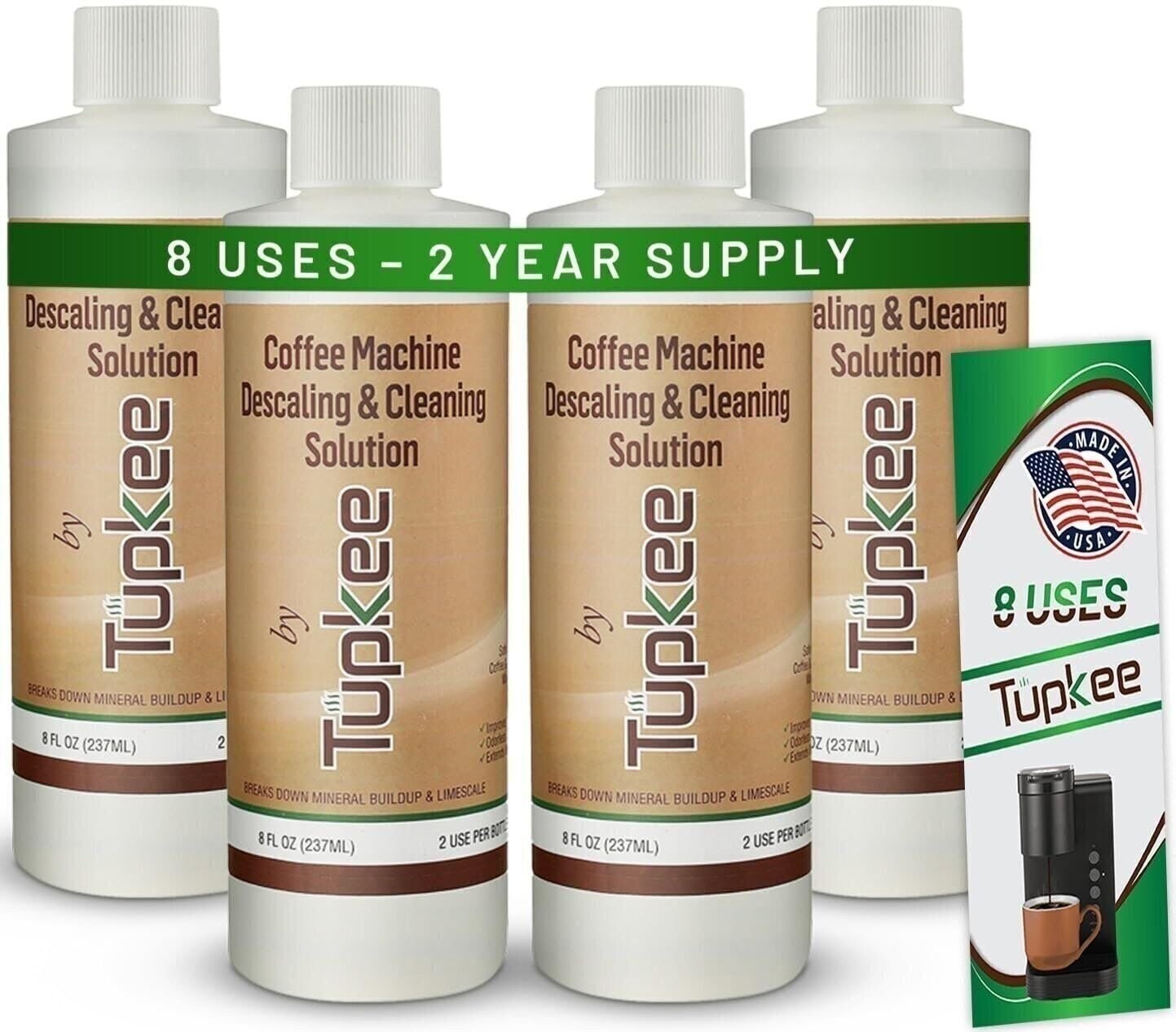

Photos from current listings. Actual item, color, and included accessories may vary.
Keurig Descaling Solution Buying Guide
Keurig descaling solution is a citric-acid-based cleaner formulated to dissolve calcium and magnesium scale from the boiler, brew line, and needle of Keurig K-Cup machines. The core trade-off is between OEM single-use bottles that guarantee compatibility and concentration versus bulk citric-acid powders or third-party liquids that cost far less per cycle but require you to mix and flush correctly. The decision rule: buy any food-grade citric-acid product with a clear dilution ratio and a rinse instruction, skip vinegar-only or abrasive cleaners that degrade rubber seals and leave odor.
Key takeaways
- Keurig's own descaler is a citric-acid solution, not vinegar; vinegar can harden silicone seals and leave a residual taste that requires extra rinse cycles.
- OEM bottles are pre-measured for one full descale cycle on most K-Cup models, while bulk citric-acid powder needs a 1-2 tablespoon per quart dilution and a 15-20 minute soak.
- Keurig 2.0 and K-Supreme machines have a dedicated descale mode that must be activated to clear the red descale light; older Elite and Classic models use a manual brew-and-rinse sequence.
At a glance
- Category
- Coffee Cleaning & Accessories
- Last updated
- Nov 28, 2026
Current offers
Highlights
- Keurig's own descaler is a citric-acid solution, not vinegar; vinegar can harden silicone seals and leave a residual taste that requires extra rinse cycles.
- OEM bottles are pre-measured for one full descale cycle on most K-Cup models, while bulk citric-acid powder needs a 1-2 tablespoon per quart dilution and a 15-20 minute soak.
- Keurig 2.0 and K-Supreme machines have a dedicated descale mode that must be activated to clear the red descale light; older Elite and Classic models use a manual brew-and-rinse sequence.
- Descaling frequency scales with water hardness: soft water every 3-6 months, hard water every 4-8 weeks, or whenever the machine's descale indicator triggers.
Best use cases
- Best fit for single-serve K-Cup owners who want zero mixing errors: buy pre-measured OEM or third-party liquid descaler bottles sized to one cycle and follow the machine's descale-mode prompt.
- Best fit for multi-machine or hard-water households: buy food-grade citric-acid powder in bulk and mix per the label ratio; it treats the same scale at a fraction of the per-cycle cost and stores indefinitely.
- Wrong fit: white vinegar or generic all-purpose cleaners — they can leave odor, degrade seals, and do not carry a descale-mode-compatible rinse profile; skip them for any Keurig with a descale indicator.
- Wrong fit: buying a descaler without confirming your model's descale procedure — K-Supreme, K-Slim, and K-Express each use a specific button sequence that the solution alone will not complete.
Buying tips
- Match the format to your machine's descale routine: OEM pre-measured bottles for one-cycle simplicity, bulk citric-acid powder (1-2 tbsp per quart) for cost-per-clean and multi-machine use.
- Confirm the active ingredient is food-grade citric acid at 10-15% concentration for liquids, or 100% citric-acid powder for mixing; avoid hydrochloric, sulfamic, or bleach-based descalers on Keurig aluminum and silicone parts.
- Check the rinse requirement: any descaler that does not specify a full fresh-water rinse cycle (at least one reservoir flush) risks residual acid in the first brew.
- For machines with a descale light (K-Supreme, K-Slim, K-Express, K-Duo), buy a solution whose label explicitly references Keurig descale-mode compatibility rather than generic drip-coffee descaler.
Specs
| Active Ingredient | Citric acid (food-grade) |
|---|---|
| Format | Liquid bottle vs powder mix |
| Cycle Yield | 1 pre-measured cycle vs bulk multi-use |
| Compatibility | K-Cup / K-Supreme / K-Slim / Classic |
What to check before buying
- Identify your Keurig model and whether it has a descale indicator light — the button sequence and solution volume differ between 2.0, K-Supreme, K-Slim, and Classic lines.
- Measure your water hardness with a test strip or check your municipal report; hard water (above 120 ppm) demands more frequent descaling and favors bulk powder for cost.
- Confirm you have a full fresh-water reservoir and a large empty container (at least 1 liter) to catch discharge during the descale and rinse cycles.
- Check that the descaler is food-grade citric acid and that the label gives a dilution ratio or pre-measured volume — no ratio means no reliable clean.
FAQ
Data sources: eBay / Amazon listings and product attribute feeds. Updated Nov 28, 2026.
Some links on this page are affiliate links. If you buy after clicking one, we may earn a commission at no extra cost to you. This does not change which products appear here or their order. Affiliate disclosure.