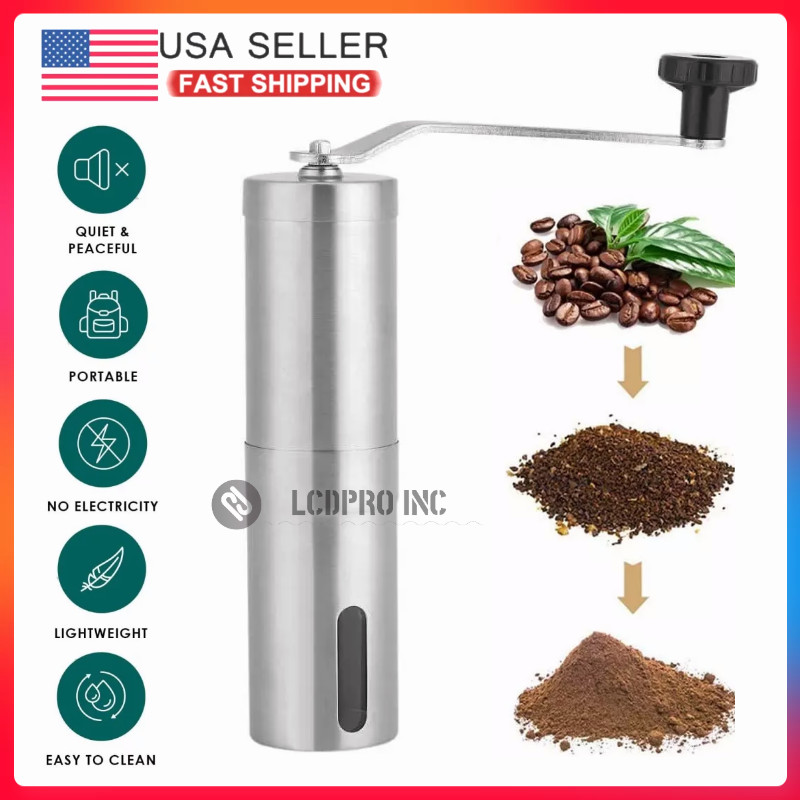

Photos from current listings. Actual item, color, and included accessories may vary.
Hand Burr Coffee Grinder Buying Guide
Hand burr grinders replace spinning blades with a conical or flat burr set driven by arm power, giving you a repeatable particle size critical for pour-over, Aeropress, and espresso. The core trade-off is burr material and axle stability: ceramic burrs resist wear and heat but chip if dropped, while hardened steel cuts faster and handles fine espresso but can rust without care. Choose a grinder with dual axle bearings and a locking or stepped adjustment ring; avoid single-bearing, press-fit designs that wobble and produce boulders and fines.
Median $111.27 · Pre-owned listings
Key takeaways
- Burr material decides longevity and speed: ceramic (alumina) stays sharp for years and never rusts but is brittle; hardened steel (stainless or coated) grinds 2-3x faster at espresso fineness but needs dry storage.
- Axle support separates stable from sloppy: dual sealed ball bearings top and bottom hold the burr concentric, while a single bushing or plastic sleeve lets the inner burr wobble and skew the grind distribution.
- Adjustment mechanism sets repeatability: stepped rings with detents click into known settings for brew method switching, while stepless collars allow micro-tuning for espresso but drift without a locking screw.
At a glance
- Category
- Coffee Grinders
- Last updated
- Nov 28, 2026
Current offers
Highlights
- Burr material decides longevity and speed: ceramic (alumina) stays sharp for years and never rusts but is brittle; hardened steel (stainless or coated) grinds 2-3x faster at espresso fineness but needs dry storage.
- Axle support separates stable from sloppy: dual sealed ball bearings top and bottom hold the burr concentric, while a single bushing or plastic sleeve lets the inner burr wobble and skew the grind distribution.
- Adjustment mechanism sets repeatability: stepped rings with detents click into known settings for brew method switching, while stepless collars allow micro-tuning for espresso but drift without a locking screw.
- Capacity and ergonomics scale with burr size: 38-40 mm burrs suit 20-30 g single doses with a compact body, while 48 mm+ burrs cut faster and fit 40-60 g hoppers but add crank torque and weight.
Best use cases
- Pour-over and drip daily brewing: pick a 38-40 mm ceramic burr with 15-20 click steps and a 25-30 g capacity; skip stepless espresso-focused models whose fine adjustment is wasted on coarse grinds.
- Aeropress and travel kit: choose a compact stainless-steel-body model under 500 g with a detachable crank and 20 g capacity; skip large-hopper 48 mm grinders that add bulk and torque without benefit for 15-18 g doses.
- Espresso and moka pot at home: require a stepless or 40+ step adjustment with dual bearings and steel burrs to hit the 200-300 micron range; skip click-only 10-step grinders that cannot dial in a 25-30 second shot.
- High-volume or shared kitchen (40 g+ per brew): pick a 48 mm burr with a 40-60 g hopper and anti-slip base; skip pocket-sized 25 g grinders that need refilling mid-recipe.
Buying tips
- Match burr size to dose: 38-40 mm burrs grind 20-30 g in 45-90 seconds of cranking; 48 mm burrs cut that to 30-60 seconds but require noticeably more torque per revolution.
- Demand dual axle bearings: a top and bottom sealed bearing pair keeps the burr aligned; single-bearing or bushing designs produce inconsistent particle size within a single grind.
- Count adjustment steps: 30+ clicks or a stepless collar with lock are needed for espresso; 10-15 clicks are sufficient for French press through drip but too coarse for dialing in.
- Check burr grade and body metal: hardened stainless steel (HRC 55+) or fine-grain ceramic resists wear; 304 stainless or aluminum bodies survive drops, while thin painted steel dents and chips.
Specs
| Burr Material | Ceramic (alumina) vs hardened steel |
|---|---|
| Burr Diameter | 38-40 mm compact vs 48 mm+ high-volume |
| Adjustment Type | Stepped clicks vs stepless with lock |
| Axle Support | Dual ball bearings vs single bushing |
Related searches
What to check before buying
- Measure your counter and cabinet clearance: most hand grinders stand 16-20 cm tall, so confirm the grinder plus crank swing (25-30 cm radius) fits under upper cabinets.
- Confirm hopper capacity versus your brew: 20-25 g covers one to two cups; households brewing 40 g+ per pot need a 40-60 g hopper or accept a refill mid-grind.
- Verify burr replacement and cleaning access: the bottom burr should unscrew or unclip without tools; sealed or glued assemblies cannot be cleaned of retained fines and stale oils.
- Check crank and grip ergonomics: a folding or detachable handle eases storage, and a rubber or knurled grip reduces hand slip when grinding light roasts at fine settings.
FAQ
Data sources: eBay / Amazon listings and product attribute feeds. Updated Nov 28, 2026.
Some links on this page are affiliate links. If you buy after clicking one, we may earn a commission at no extra cost to you. This does not change which products appear here or their order. Affiliate disclosure.