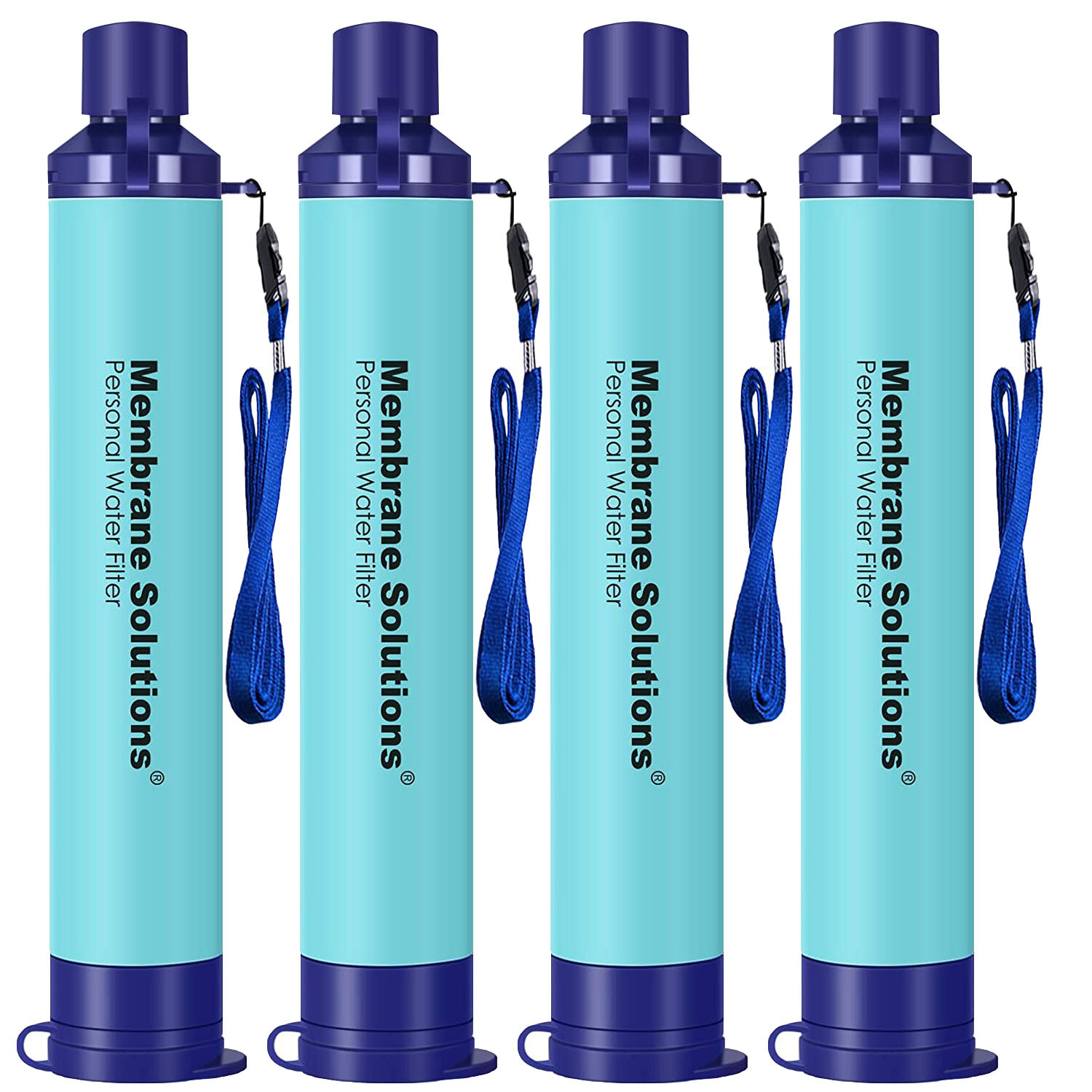

Photos from current listings. Actual item, color, and included accessories may vary.
Portable Water Filter Straw Buying Guide
Portable water filter straws are personal, direct-drink purifiers that remove sediment, protozoa, and bacteria without pumps or power, trading flow rate and lifespan for packability. The core decision is membrane absolute rating versus hollow-fiber surface area: 0.1-micron absolute hollow-fiber units last hundreds of liters, while 0.2-micron nominal or granular-carbon units are lighter but shorter-lived. Buy a 0.1-micron absolute hollow-fiber straw if you need dependable backcountry or emergency water; skip carbon-only or nominal-rated straws for anything beyond clear municipal water.
Median $151.49
Key takeaways
- Hollow-fiber membrane pore rating: 0.1-micron absolute removes bacteria and protozoa; 0.2-micron nominal is a looser, shorter-life spec.
- Filter capacity scales with membrane surface area: compact straws rate roughly 100-500 L, larger hollow-fiber cartridges 1,000-2,000 L.
- Most straws use 0.1-micron hollow fiber with no iodine or UV stage; they do not remove viruses or dissolved chemicals.
At a glance
- Category
- Water Filtration
- Last updated
- Nov 28, 2026
Current offers
Highlights
- Hollow-fiber membrane pore rating: 0.1-micron absolute removes bacteria and protozoa; 0.2-micron nominal is a looser, shorter-life spec.
- Filter capacity scales with membrane surface area: compact straws rate roughly 100-500 L, larger hollow-fiber cartridges 1,000-2,000 L.
- Most straws use 0.1-micron hollow fiber with no iodine or UV stage; they do not remove viruses or dissolved chemicals.
- Flow rate drops as the membrane loads; backflushing with clean water restores most of the original throughput.
Best use cases
- Backpacking and day hikes: pick a 0.1-micron hollow-fiber straw weighing under 2 oz; skip carbon-only straws that clog and expire fast.
- Emergency kits and travel: choose a straw with a rated 500+ L lifespan and a capped bite valve; skip open-tip designs that leak in a bag.
- Clear municipal tap water abroad: a granular-carbon or carbon-block straw improves taste and reduces chlorine; skip it for turbid or suspect water.
- Group basecamp or muddy sources: use a squeeze or gravity hollow-fiber system instead of a straw; a single straw is too slow for shared volume.
Buying tips
- Confirm the pore rating is 0.1-micron absolute, not nominal; absolute ratings guarantee protozoa and bacteria removal at the stated size.
- Match capacity to trip length: 100-500 L suits weekenders, 1,000-2,000 L hollow-fiber cartridges suit thru-hikers and long emergency use.
- Check inlet prefilter presence: a mesh or foam prefilter extends membrane life significantly in silty or glacial water.
- Prefer a straw with a backflush syringe or integrated backflush port; without it, loaded membranes lose flow permanently.
Specs
| Pore Rating | 0.1-micron absolute hollow fiber |
|---|---|
| Filter Capacity | 100-500 L compact / 1,000-2,000 L cartridge |
| Removal Scope | Bacteria & protozoa; not viruses |
| Weight Class | 1-3 oz straw / 2-4 oz cartridge |
Related searches
What to check before buying
- Verify the straw fits your water container: standard straw tips work in wide-mouth bottles, while squeeze-bladder setups need a threaded adapter.
- Confirm the filter's rated operating temperature; freezing a wet hollow-fiber membrane cracks it and destroys filtration.
- Check whether spare bite valves, O-rings, and backflush syringes are included or sold separately before committing to a model.
- Match the straw's diameter to your pack's hydration sleeve or bottle opening so it stores without kinking.
FAQ
Data sources: eBay / Amazon listings and product attribute feeds. Updated Nov 28, 2026.
Some links on this page are affiliate links. If you buy after clicking one, we may earn a commission at no extra cost to you. This does not change which products appear here or their order. Affiliate disclosure.