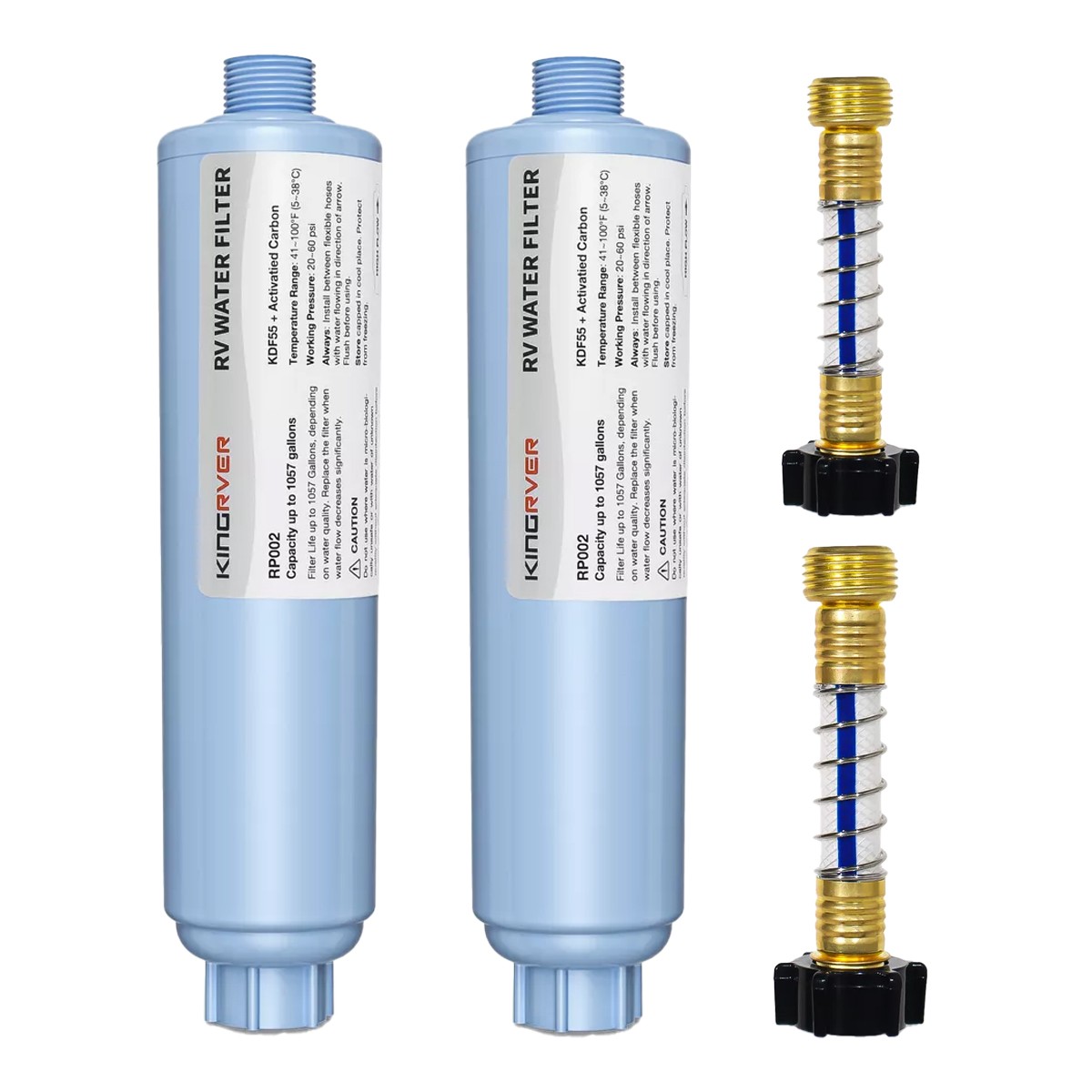

Photos from current listings. Actual item, color, and included accessories may vary.
RV Water Filter Buying Guide
An RV water filter is an inline canister that connects between the campground spigot and your rig's hose to reduce sediment, chlorine, and taste/odor before water reaches tank or faucet. The core trade-off is micron rating and chlorine capacity versus flow rate and pressure drop. Buy a granular-activated-carbon block filter rated at 0.5–5 microns with a known gallon capacity if you drink and cook from the tank; skip cheap loose-carbon or sediment-only cartridges for potable use.
Key takeaways
- Carbon block vs granular carbon: block filters trap 0.5–5 micron particles and resist channeling; loose granular carbon lets water bypass and sheds fines.
- Chlorine capacity is rated in gallons (typically 1,000–3,000 gal); high-capacity models trade canister size and flow for longer service life.
- Hose-end inline filters are 3/4 in GHT male-to-female pass-through; canister and under-sink types use NPT or push-fit fittings and need adapters.
At a glance
- Category
- Water Filtration
- Last updated
- Nov 28, 2026
Current offers
Highlights
- Carbon block vs granular carbon: block filters trap 0.5–5 micron particles and resist channeling; loose granular carbon lets water bypass and sheds fines.
- Chlorine capacity is rated in gallons (typically 1,000–3,000 gal); high-capacity models trade canister size and flow for longer service life.
- Hose-end inline filters are 3/4 in GHT male-to-female pass-through; canister and under-sink types use NPT or push-fit fittings and need adapters.
- Two-stage setups (sediment 5–20 micron prefilter + carbon block) protect the carbon stage and maintain flow better than a single cartridge.
Best use cases
- Full-time RVers and families drinking from the tank: choose a 0.5–1 micron carbon block with 2,000+ gal chlorine capacity and a sediment prefilter; skip single-stage loose-carbon cartridges.
- Weekend campers filling from municipal water: a standard 5 micron carbon block inline (1,000–1,500 gal) is sufficient; skip high-capacity two-stage systems if you drain and winterize frequently.
- Well-water or heavily chlorinated campgrounds: use a two-stage canister with 5 micron prefilter plus 0.5 micron carbon block; skip hose-end-only filters that clog quickly on sediment.
Buying tips
- Match micron rating to use: 0.5–1 micron carbon block for potable drinking water, 5–20 micron for sediment protection upstream; never use a sediment-only cartridge as your sole drinking-water filter.
- Size chlorine capacity to your usage: a 3-person crew at 2 gal/day drinking/cooking over 90 days needs roughly 540 gal, so a 1,000 gal filter lasts about a season; full-timers should pick 2,000+ gal.
- Confirm thread standard: RV hose-end filters use 3/4 in GHT; canister filters often use NPT or 1/2 in push-fit, so buy the correct adapter or hose fittings before installation.
- Check flow rate at 40–60 psi: carbon block filters typically pass 1.5–3 gpm; if you demand higher flow (showers, washer), use a larger canister or two-stage parallel setup to avoid pressure drop.
Specs
| Filtration Media | Carbon block vs granular carbon |
|---|---|
| Micron Rating | 0.5–20 micron (0.5–1 for potable) |
| Chlorine Capacity | 1,000–3,000 gallons |
| Thread Standard | 3/4 in GHT (hose-end) / NPT |
Related searches
What to check before buying
- Measure your hose bib spacing and storage bay: a standard inline filter is about 2.5 in diameter and 10–12 in long; canister systems need 12–18 in clearance and a mounting bracket.
- Verify campground water pressure: above 60 psi requires a pressure regulator before the filter to prevent cartridge housing failure; below 30 psi expect reduced flow through fine carbon blocks.
- Confirm winterization method: canister filters must be drained and cartridges removed or bypassed for freeze protection; inline hose-end filters are removed entirely.
- Check plug/voltage only if adding UV or pump stages: most RV filters are passive, but UV sterilizers need 12 V DC or 120 V AC and a dedicated circuit.
FAQ
Data sources: eBay / Amazon listings and product attribute feeds. Updated Nov 28, 2026.
Some links on this page are affiliate links. If you buy after clicking one, we may earn a commission at no extra cost to you. This does not change which products appear here or their order. Affiliate disclosure.