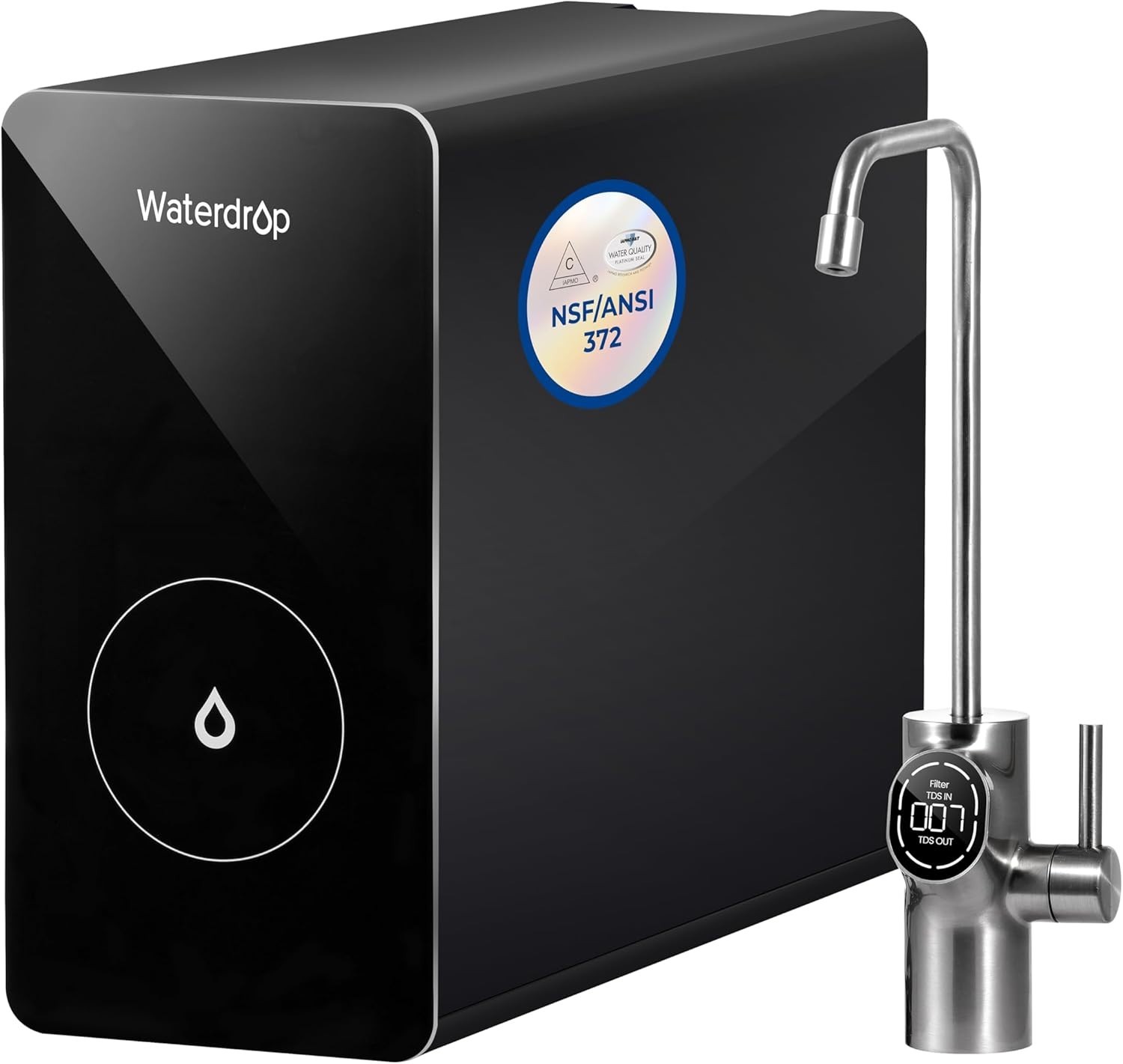

Photos from current listings. Actual item, color, and included accessories may vary.
Under Sink Buying Guide
Under-sink filtration spans simple carbon blocks to full reverse-osmosis systems, so the first decision is whether you need sediment/chlorine removal or dissolved-solids reduction. Space under the cabinet, feed-water pressure, and whether you want a tank or tankless design determine which architecture fits. Most buyer mistakes come from skipping the drain-saddle and faucet-hole requirements before ordering.
Key takeaways
- Tankless RO systems like the Waterdrop D6 run 600 GPD and eliminate the pressure tank, freeing cabinet space but requiring a dedicated power outlet under the sink.
- Carbon block and KDF cartridges reduce chlorine, taste, and odor at high flow with no wastewater; they do not lower TDS or remove nitrates and heavy metals.
- RO membranes are rated in gallons per day (50–800 GPD); higher GPD needs higher feed pressure and produces more reject water unless a permeate pump is added.
At a glance
- Category
- Water Filtration
- Last updated
- Nov 28, 2026
Current offers
Highlights
- Tankless RO systems like the Waterdrop D6 run 600 GPD and eliminate the pressure tank, freeing cabinet space but requiring a dedicated power outlet under the sink.
- Carbon block and KDF cartridges reduce chlorine, taste, and odor at high flow with no wastewater; they do not lower TDS or remove nitrates and heavy metals.
- RO membranes are rated in gallons per day (50–800 GPD); higher GPD needs higher feed pressure and produces more reject water unless a permeate pump is added.
- Housings are standardized as 10-inch or 20-inch slimline and big-blue; cartridge diameter and thread pitch must match the housing brand or the element will not seal.
Best use cases
- Choose a tankless 600 GPD RO like the Waterdrop D6 for a family of four on municipal water who wants low-TDS drinking water and has an outlet plus a 1.5-inch faucet hole available.
- Pick a two-stage carbon block under-sink filter if you only want to remove chlorine taste and odor and cannot spare cabinet height for a tank or run power.
- Skip RO entirely on private well water with high iron or hardness unless you add a softener and sediment pre-filter first; raw well water fouls membranes quickly.
Buying tips
- Measure cabinet interior height, width, and depth before choosing tank vs tankless; a standard pressure tank adds roughly 10–12 inches of height and 9–12 inches of diameter.
- Confirm feed pressure stays between 40 and 80 psi for RO membranes; below 40 psi output drops sharply and above 80 psi requires a pressure-reducing valve.
- Inspect your existing faucet hole: most under-sink systems need a 1.25–1.5 inch opening, and air-gap faucets require an extra hole for the drain line.
- Compare cartridge availability and replacement interval; annual sediment/carbon changes and 2–3 year RO membrane changes are the normal service rhythm.
Specs
| Filtration Type | Carbon block / RO / RO+DI |
|---|---|
| RO Capacity | 50–800 GPD (tank vs tankless) |
| Housing Standard | 10" or 20" slimline / big blue |
| Feed Pressure | 40–80 psi (RO membrane) |
Related searches
What to check before buying
- Cabinet clearance: measure height, width, and door swing with the system and any tank in place before purchase.
- Drain access: verify a drain saddle can be mounted on the sink drain pipe above the P-trap and that the pipe is 1.25–1.5 inch OD.
- Power and plumbing: tankless RO needs a nearby GFCI outlet; all systems need a cold-water supply valve and 3/8-inch feed connection.
- Faucet hole: confirm an unused 1.25–1.5 inch hole exists or plan to drill one in a compatible countertop material.
FAQ
Data sources: eBay / Amazon listings and product attribute feeds. Updated Nov 28, 2026.
Some links on this page are affiliate links. If you buy after clicking one, we may earn a commission at no extra cost to you. This does not change which products appear here or their order. Affiliate disclosure.