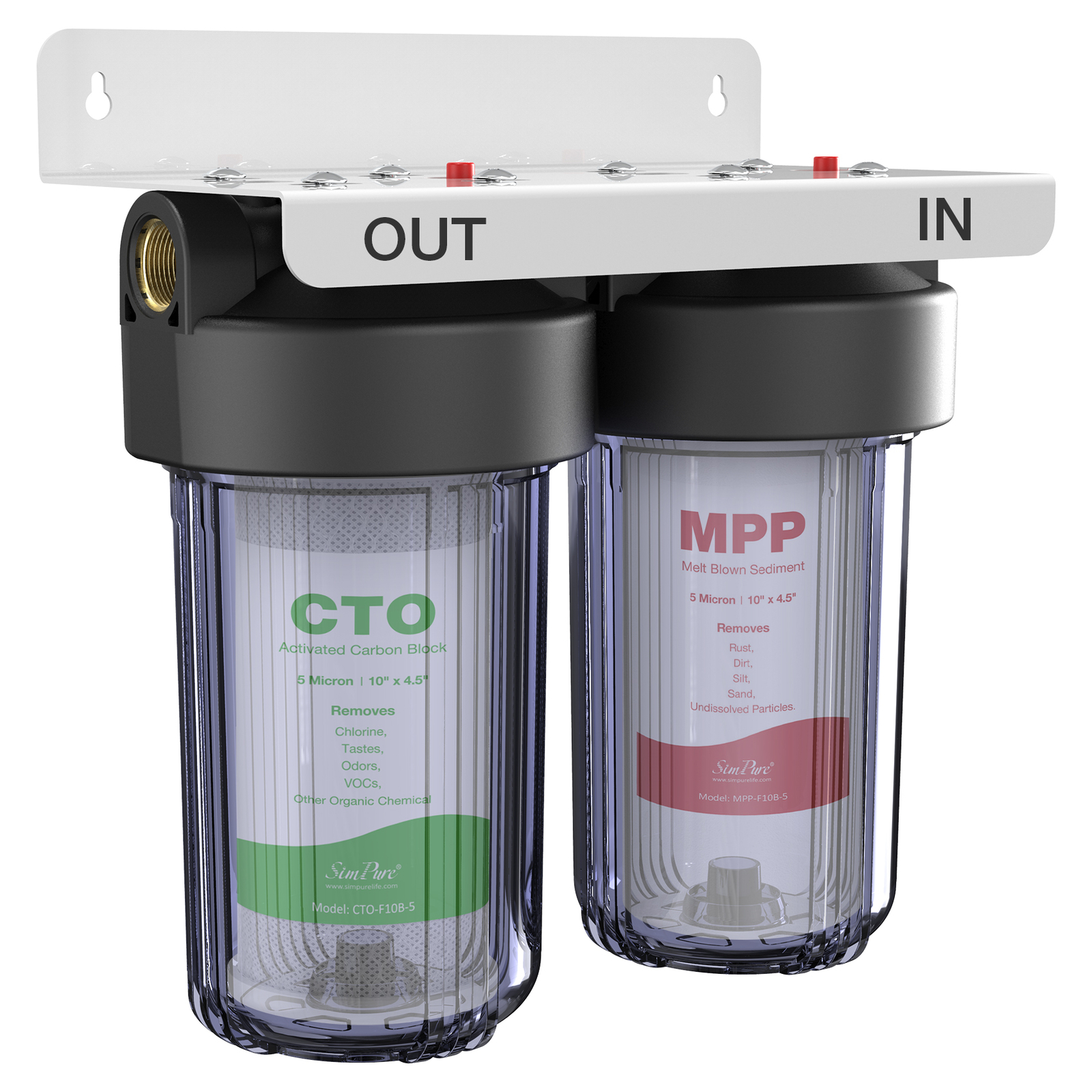

Photos from current listings. Actual item, color, and included accessories may vary.
Well Water Filter Buying Guide
Whole-house well water filters are pressure vessels and media tanks that remove sediment, iron, sulfur, and hardness before water reaches fixtures. The primary trade-off is capacity versus backwash/maintenance burden: larger media beds and higher-service-flow valves cost more but deliver longer runs between service. The decision rule is to match the system to your water chemistry test results and peak flow demand, not to the largest gallon rating printed on the box.
Key takeaways
- Sediment cartridges are rated in nominal microns: 5-micron melts remove fine silt and sand, 20-micron pleated cartridges handle heavier loads with less pressure drop.
- Iron and manganese require oxidizing media (air injection, greensand, or Birm) because standard carbon block filters saturate quickly and pass dissolved iron through.
- Tank and head materials differ: stainless-steel or fiberglass-reinforced polymer tanks resist corrosion and UV, while thin plastic housings crack under pressure cycling.
At a glance
- Category
- Water Filtration
- Last updated
- Nov 28, 2026
Current offers
Highlights
- Sediment cartridges are rated in nominal microns: 5-micron melts remove fine silt and sand, 20-micron pleated cartridges handle heavier loads with less pressure drop.
- Iron and manganese require oxidizing media (air injection, greensand, or Birm) because standard carbon block filters saturate quickly and pass dissolved iron through.
- Tank and head materials differ: stainless-steel or fiberglass-reinforced polymer tanks resist corrosion and UV, while thin plastic housings crack under pressure cycling.
- Whole-house systems use 3/4-inch or 1-inch NPT ports; undersized ports choke flow below 8-10 GPM and cause pressure loss at multiple fixtures.
Best use cases
- Best fit: a 10-inch Big Blue two-stage sediment system for clear well water with sand or grit and no iron; skip it if your test shows ferrous iron above 0.3 ppm.
- Best fit: an air-injection or greensand backwashing filter for well water with iron, manganese, or sulfur odor; skip carbon-only housings because they foul within weeks.
- Best fit: a water softener paired with sediment pre-filtration when hardness exceeds 7 grains per gallon; skip standalone carbon filters, which do not remove calcium or magnesium.
- Wrong fit: undersink or countertop filters for well water whole-house treatment; they lack the flow rate and media volume to protect plumbing and appliances.
Buying tips
- Size sediment cartridges by micron rating and surface area: two 4.5 x 10-inch cartridges in series give better loading capacity than one 4.5 x 20-inch cartridge at the same micron.
- Match backwashing filter media to your lab test: pH below 7.0 requires pH correction before iron filters, or the media will not oxidize dissolved iron.
- Confirm the control valve's service flow rating in GPM; a 1-inch valve typically handles 10-15 GPM, adequate for a 3-bathroom home with simultaneous fixtures.
- Choose fiberglass-wound or stainless pressure tanks with a minimum 100-psi working rating; thin blow-molded plastic housings are not rated for well pump pressure spikes.
Specs
| Filter Architecture | Sediment cartridge vs backwash media |
|---|---|
| Port Size | 3/4 in vs 1 in NPT |
| Micron Rating | 1 / 5 / 20 / 30 micron nominal |
| Tank Construction | Fiberglass, stainless, or polymer |
Related searches
What to check before buying
- Measure the installation space: a 10-inch Big Blue pair needs about 18 inches of wall width, while a 10 x 54-inch backwash tank needs 24 inches of diameter clearance and 66 inches of height.
- Test raw well water for iron, manganese, hardness, pH, and sulfur before selecting media; these five values determine which filter architecture works.
- Verify incoming pressure at the tank tee; systems with 40-60 psi pump cut-in/cut-out work with standard valves, but above 80 psi requires a pressure-reducing valve.
- Check that the filter bypass and drain line can reach a floor drain or exterior discharge for backwash cycles of 10-15 minutes at 5-10 GPM.
FAQ
Data sources: eBay / Amazon listings and product attribute feeds. Updated Nov 28, 2026.
Some links on this page are affiliate links. If you buy after clicking one, we may earn a commission at no extra cost to you. This does not change which products appear here or their order. Affiliate disclosure.