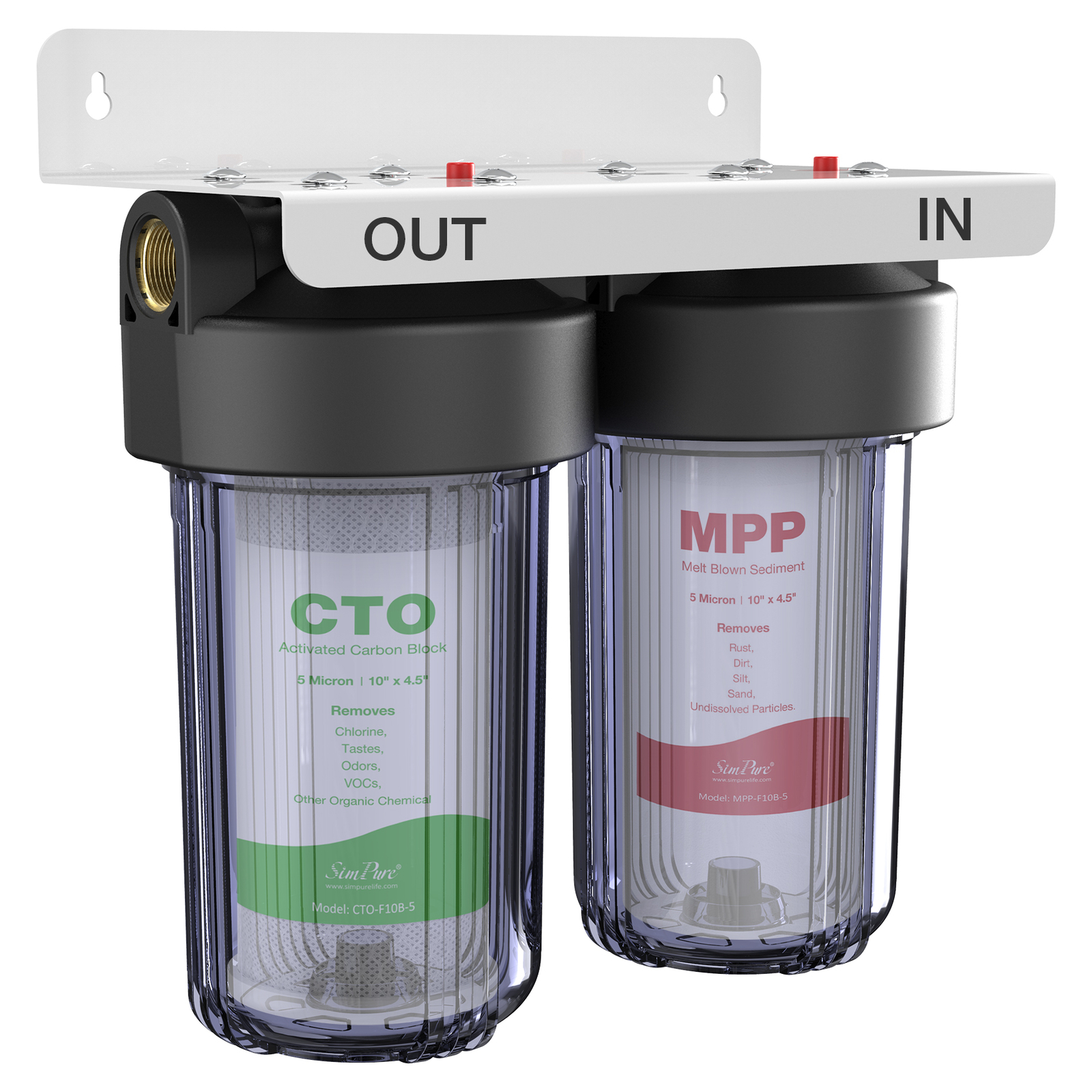

Photos from current listings. Actual item, color, and included accessories may vary.
Well Water System Buying Guide
A well water system is a multi-stage treatment train that removes sediment, iron, sulfur, and hardness from private groundwater before it reaches fixtures. The core trade-off is between basic Big Blue-style sediment filtration and full oxidation/softening trains that handle dissolved contaminants. Choose based on a lab water test, not guesswork: sediment-only for clear water, iron/sulfur oxidation for metallic or rotten-egg water, and softening when hardness exceeds 7 grains per gallon.
Key takeaways
- Big Blue housings (4.5" x 10" or 20" cartridges) handle high sediment loads but do not remove dissolved iron, sulfur, or hardness—they are pre-filters only.
- Cartridge micron rating determines filtration: 20-30 micron for well sediment pre-filtration, 5 micron for taste/odor polishing, 1 micron or below for cyst reduction.
- Iron and sulfur require oxidation (air injection, ozone, or chemical feed) followed by filtration; simple sediment cartridges clog rapidly and fail on ferrous iron above 0.3 ppm.
At a glance
- Category
- Water Filtration
- Last updated
- Nov 28, 2026
Current offers
Highlights
- Big Blue housings (4.5" x 10" or 20" cartridges) handle high sediment loads but do not remove dissolved iron, sulfur, or hardness—they are pre-filters only.
- Cartridge micron rating determines filtration: 20-30 micron for well sediment pre-filtration, 5 micron for taste/odor polishing, 1 micron or below for cyst reduction.
- Iron and sulfur require oxidation (air injection, ozone, or chemical feed) followed by filtration; simple sediment cartridges clog rapidly and fail on ferrous iron above 0.3 ppm.
- Softening capacity is sized in grains of hardness removed between regenerations; a 1-cubic-foot resin tank handles roughly 30,000-32,000 grains, sufficient for a 3-4 person household at moderate hardness.
Best use cases
- Best fit for sediment-only well water: a Big Blue whole-house sediment system with 20" 5-micron cartridges protects downstream plumbing and appliances—skip it if water tests show iron above 0.3 ppm or hardness above 7 gpg.
- Best fit for iron and sulfur: an air-injection oxidation tank paired with a backwashing filter removes ferrous iron up to 10 ppm and hydrogen sulfide odor—skip chemical-free designs if iron exceeds 15 ppm or bacteria are present.
- Best fit for hard well water: a demand-initiated regeneration softener sized to daily household water use—skip twin-tank systems for single-family homes unless continuous soft water during regeneration is required.
- Wrong fit: undersized 10" cartridge housings on high-sediment wells; they clog weekly and restrict flow—use dual 20" Big Blue stages as a minimum for turbid well water.
Buying tips
- Size the softener by household occupancy and hardness: multiply daily gallons (75 per person) by hardness in gpg, then add 20% reserve to get daily grain removal; choose a resin volume matching that figure.
- Match micron rating to use: 20-30 micron pre-filter for well sediment, 5 micron for general whole-house polishing, 1 micron for fine silt or cyst concerns—never use a 1-micron cartridge as the sole sediment filter on a turbid well.
- Select housings with 1" NPT ports for whole-house flow (10-15 gpm); 3/4" ports restrict flow to 5-7 gpm and cause pressure drop at multiple fixtures.
- For iron and sulfur, oxidation must precede filtration: air-injection or ozone systems require a backwashing filter with a minimum 10 gpm backwash rate to flush captured contaminants.
Specs
| Filtration Stage | Sediment / Oxidation / Softener |
|---|---|
| Micron Rating | 20-30 / 5 / 1 micron |
| Port Size | 1" NPT vs 3/4" NPT |
| Cartridge Size | 4.5" x 10" or 4.5" x 20" |
Related searches
What to check before buying
- Measure incoming water pressure and flow rate at the well tank: systems require 30-50 psi and 10-15 gpm for whole-house backwashing; below 30 psi needs a booster pump.
- Verify electrical and drain access near the install point: softeners and backwashing filters need a GFCI outlet and a drain line within 15 feet.
- Confirm pipe size and thread standard at the entry point (1" NPT typical); 3/4" plumbing limits total system flow regardless of filter capacity.
- Check water test results for iron, manganese, hardness, pH, and bacteria: pH below 6.5 requires acid neutralization before oxidation or softening equipment.
FAQ
Data sources: eBay / Amazon listings and product attribute feeds. Updated Nov 28, 2026.
Some links on this page are affiliate links. If you buy after clicking one, we may earn a commission at no extra cost to you. This does not change which products appear here or their order. Affiliate disclosure.