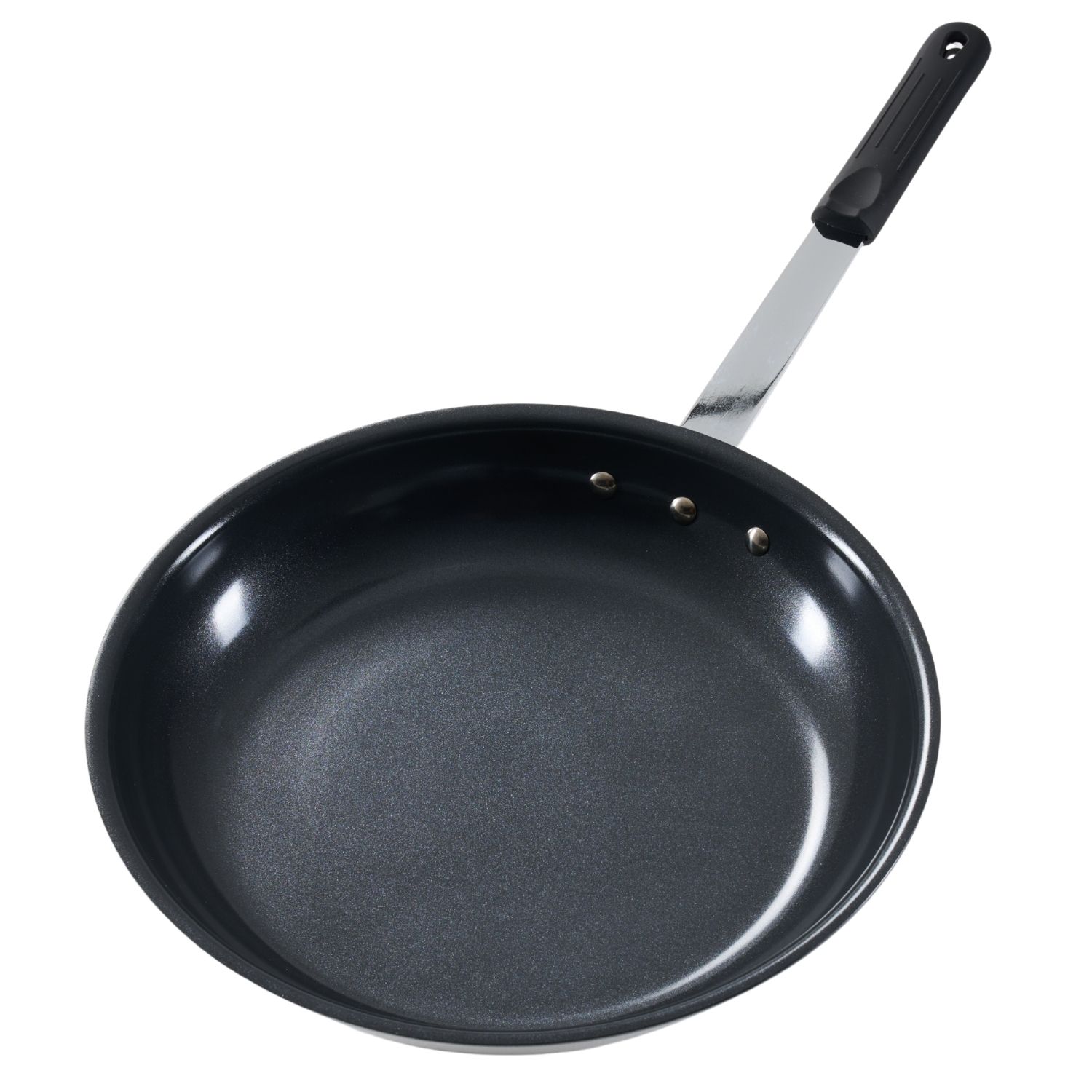

Photos from current listings. Actual item, color, and included accessories may vary.
Ceramic Frying Pan Buying Guide
Ceramic frying pans use a sol-gel mineral coating on an aluminum or stainless-steel body to deliver PTFE-free nonstick release. The core trade-off is coating durability versus clean cooking: ceramic releases well initially but degrades faster than PTFE, so construction quality and coating thickness decide lifespan. Choose a ceramic pan only for low-to-medium heat egg and delicate tasks; for daily high-heat searing, pick a clad stainless or cast-iron pan instead.
Key takeaways
- Ceramic coatings are sol-gel silica-based, PTFE- and PFOA-free, and safe to 450-500°F but lose release after roughly 6-12 months of daily use.
- Aluminum bodies heat fast and evenly but require a stainless-steel base plate for induction compatibility; full-clad stainless bodies are heavier and more durable.
- Coating thickness and number of sprayed layers determine abrasion resistance more than brand; 2-3 layer coatings outperform single-layer sprays.
At a glance
- Category
- Cookware & Cutlery
- Last updated
- Nov 28, 2026
Current offers
Highlights
- Ceramic coatings are sol-gel silica-based, PTFE- and PFOA-free, and safe to 450-500°F but lose release after roughly 6-12 months of daily use.
- Aluminum bodies heat fast and evenly but require a stainless-steel base plate for induction compatibility; full-clad stainless bodies are heavier and more durable.
- Coating thickness and number of sprayed layers determine abrasion resistance more than brand; 2-3 layer coatings outperform single-layer sprays.
- Oven-safe ratings depend on handle material: riveted stainless handles reach 450-500°F, while painted or plastic handles typically cap at 350°F.
Best use cases
- Best fit: low-to-medium heat egg, pancake, and delicate fish cooking — pick an 8-10 inch aluminum pan with a 2-3 layer ceramic coating and riveted stainless handle.
- Wrong fit: daily high-heat searing or wok-style stir-frying — ceramic coating breaks down above 500°F; choose carbon steel or clad stainless instead.
- Best fit: induction cooktops — require a ferromagnetic stainless base plate; skip pure aluminum pans without an induction base.
- Wrong fit: dishwasher-dependent households — harsh detergents and high heat degrade ceramic coating; hand-wash to preserve release.
Buying tips
- Match pan diameter to burner: 8-inch for 1-2 eggs, 10-inch for 2-3 eggs or a single fillet; oversized pans waste heat on small burners.
- Check base construction: 'stainless steel base' means induction-ready; pure aluminum bodies are not induction-compatible without a bonded plate.
- Prefer riveted stainless handles over screw-on plastic; rivets stay tight through oven cycles and won't loosen with thermal expansion.
- Verify oven-safe temperature on the handle, not just the pan: 450°F+ requires all-metal construction; plastic handles cap at 350°F.
Specs
| Coating Type | Sol-gel ceramic (PTFE-free) |
|---|---|
| Body Material | Aluminum / stainless-clad |
| Induction Ready | Requires stainless base plate |
| Oven Safe | 350-500°F by handle type |
Related searches
What to check before buying
- Measure your largest burner and cooktop space: an 8-inch pan needs a 6-7 inch burner; a 10-inch pan needs an 8-inch burner for even heating.
- Confirm your cooktop type: induction requires a magnetic stainless base plate; gas and electric work with any flat-bottom pan.
- Check oven clearance and rack position: pans with long stainless handles need 2-3 inches of door clearance at 450°F.
- Verify handle material and rivet type: all-metal riveted handles for oven use above 400°F; plastic or painted handles for stovetop only.
FAQ
Data sources: eBay / Amazon listings and product attribute feeds. Updated Nov 28, 2026.
Some links on this page are affiliate links. If you buy after clicking one, we may earn a commission at no extra cost to you. This does not change which products appear here or their order. Affiliate disclosure.