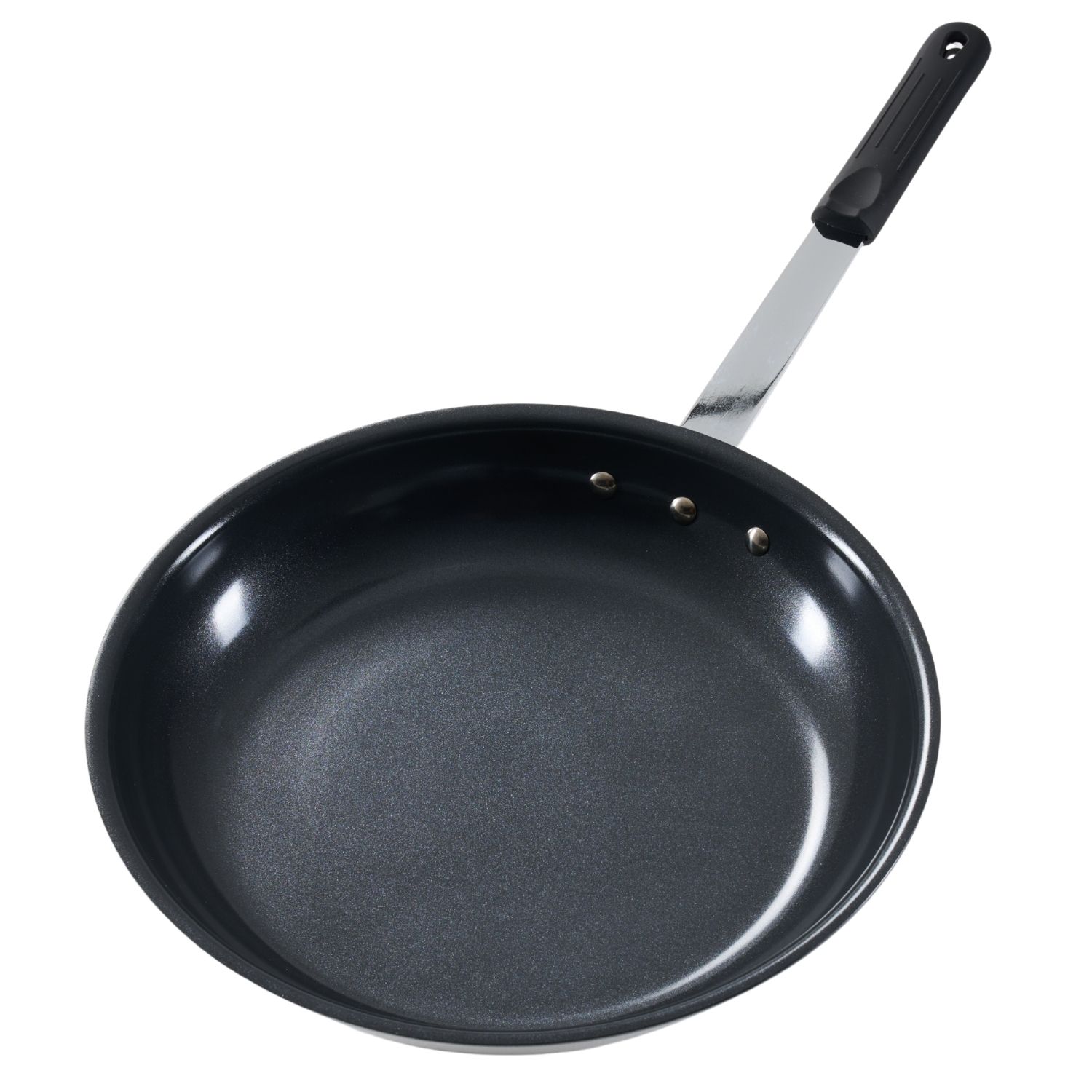

Photos from current listings. Actual item, color, and included accessories may vary.
Ceramic Non Stick Pan Buying Guide
Ceramic nonstick pans use a sol-gel or plasma-sprayed mineral coating over an aluminum or stainless-steel body, trading the longer release life of PTFE for higher heat tolerance and PFAS-free cooking. The primary trade-off is coating durability versus thermal performance: thin stamped aluminum heats fast but warps and loses release within months, while thick forged or clad bodies with a reinforced ceramic layer hold flatness and slickness far longer. The clear decision rule is to buy a pan with a discernible base thickness of at least 3 mm, a riveted or welded handle, and an explicit PFOA/PFAS-free claim — skip any pan whose only specification is 'ceramic' with no body material or coating process named.
Key takeaways
- Body material determines longevity: forged aluminum (3–5 mm base) resists warping on gas and induction, while 1.5–2 mm stamped aluminum is the most common failure point under high heat.
- Coating generation matters: early sol-gel ceramic coatings degrade in 6–12 months at daily use; reinforced or multi-layer ceramic (often marketed as 'ceramic titanium' or 'ceramic plus') extends release life toward 2–3 years.
- Induction compatibility requires a ferromagnetic base — a stainless-steel plate bonded to the aluminum or a full clad construction; pure aluminum ceramic pans are gas/electric only.
At a glance
- Category
- Cookware & Cutlery
- Last updated
- Nov 28, 2026
Current offers
Highlights
- Body material determines longevity: forged aluminum (3–5 mm base) resists warping on gas and induction, while 1.5–2 mm stamped aluminum is the most common failure point under high heat.
- Coating generation matters: early sol-gel ceramic coatings degrade in 6–12 months at daily use; reinforced or multi-layer ceramic (often marketed as 'ceramic titanium' or 'ceramic plus') extends release life toward 2–3 years.
- Induction compatibility requires a ferromagnetic base — a stainless-steel plate bonded to the aluminum or a full clad construction; pure aluminum ceramic pans are gas/electric only.
- Handle attachment defines safety: riveted stainless or welded cast handles survive oven heat to 450–500°F, while glued or screw-on plastic handles are the first component to fail.
Best use cases
- Best fit: daily egg, omelet, and low-oil sauté cooking on gas or electric — choose a 3–4 mm forged aluminum ceramic pan with a riveted stainless handle and oven rating to 450°F.
- Best fit: induction cooktops — pick only a ceramic pan with a bonded stainless base or full-clad body; a pure aluminum ceramic pan will not heat on induction regardless of coating quality.
- Wrong fit: high-heat searing and stir-frying — ceramic coatings degrade above 500°F and are not a substitute for carbon steel or cast iron; skip ceramic for wok-style cooking.
- Wrong fit: dishwasher-dependent households — despite 'dishwasher safe' labels, detergent and high heat accelerate ceramic coating breakdown; hand-wash any pan you expect to last beyond a year.
Buying tips
- Measure the base: a 10-inch pan should weigh roughly 1.5–2.5 lb with a base thickness of 3 mm or more; anything under 2 mm is stamped lightweight and will warp.
- Match diameter to burner and task: 8-inch for eggs and single servings, 10-inch for two-to-three portions, 12-inch for family sauté — oversized thin pans overhang burners and warp.
- Check the oven rating and handle material together: stainless riveted handles are rated 450–500°F; plastic or silicone-wrapped handles typically cap at 350°F and are not broiler-safe.
- Confirm PFAS-free claim and coating type: 'PFOA-free' is a minimum legal standard, not a differentiator; look for 'PFAS-free' and a stated ceramic/mineral sol-gel coating rather than generic 'nonstick'.
Specs
| Body Material | Forged aluminum / clad stainless |
|---|---|
| Coating Type | Sol-gel ceramic (PFAS-free) |
| Base Thickness | 3–5 mm forged / 1.5–2 mm stamped |
| Induction Ready | Stainless base required |
Related searches
What to check before buying
- Measure your burner and cooktop: confirm the pan diameter matches or slightly exceeds the burner ring, and verify induction compatibility if your cooktop is magnetic.
- Check cabinet and oven clearance: a 12-inch pan with a long handle needs roughly 20 inches of stovetop width and an oven rack tall enough to clear the handle.
- Confirm your heat source: gas and electric work with any ceramic pan; induction demands a stainless base or clad body — check for an induction icon or magnet test.
- Plan companion lids and storage: ceramic pans often ship without lids; verify lid diameter availability and whether the handle is oven-safe for finishing dishes under the broiler.
FAQ
Data sources: eBay / Amazon listings and product attribute feeds. Updated Nov 28, 2026.
Some links on this page are affiliate links. If you buy after clicking one, we may earn a commission at no extra cost to you. This does not change which products appear here or their order. Affiliate disclosure.