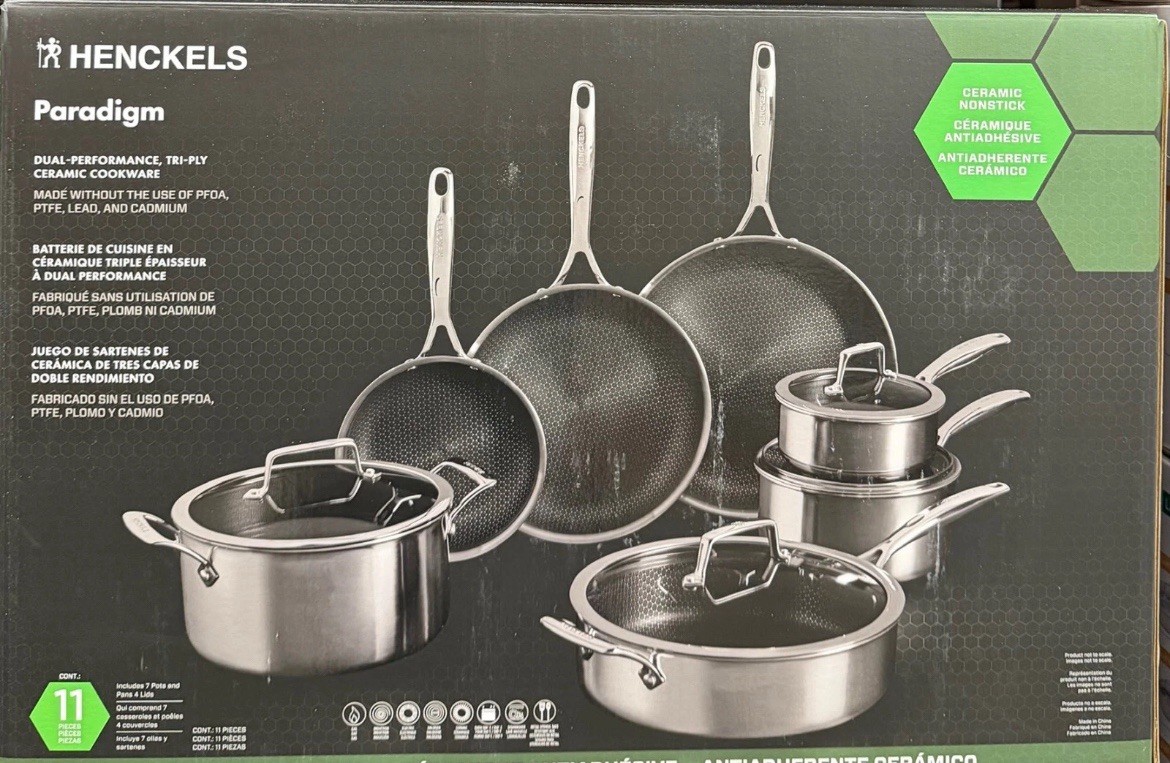

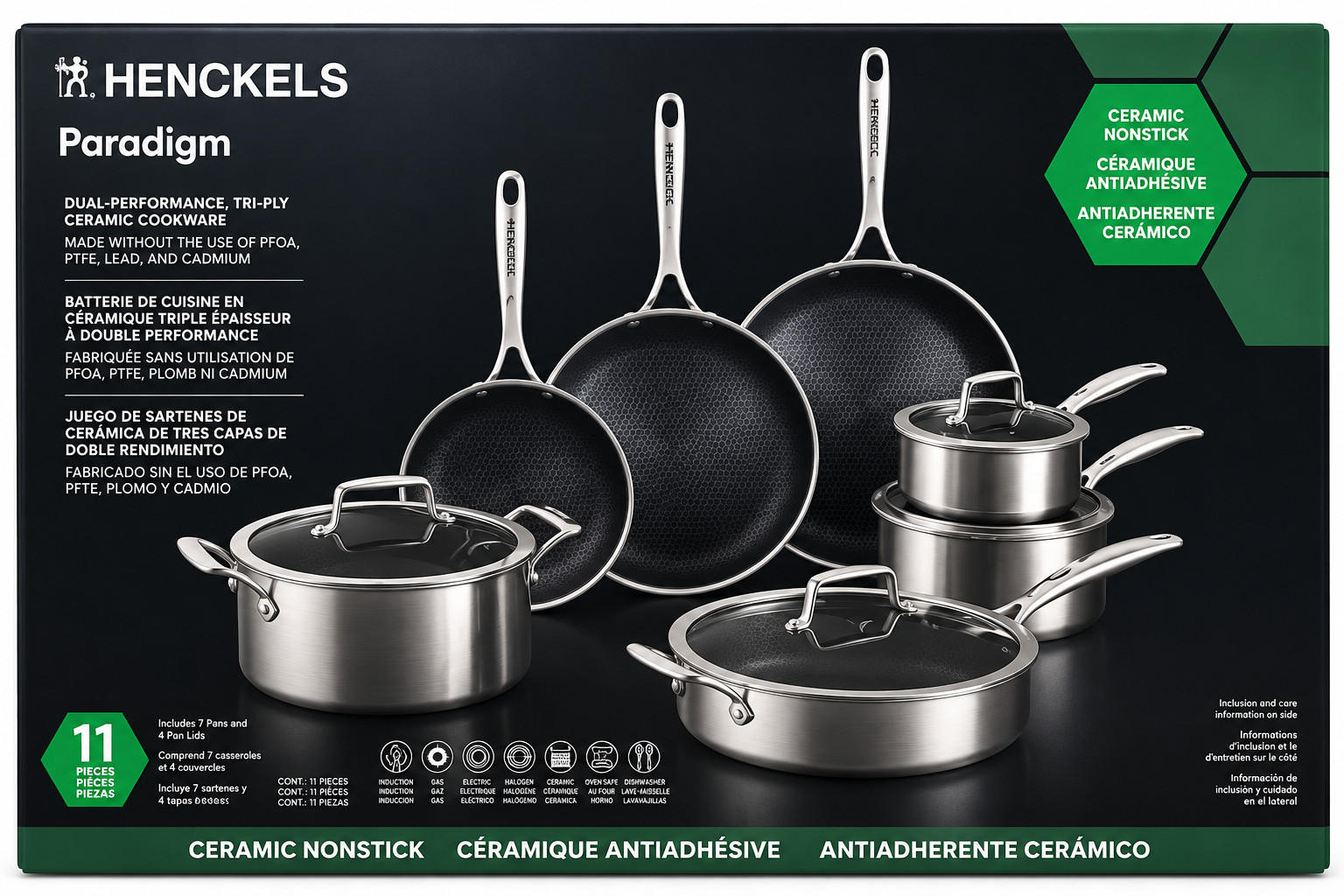
Photos from current listings. Actual item, color, and included accessories may vary.
Henckel Stainless Steel Cookware Buying Guide
Henckel stainless steel cookware spans three distinct construction tiers—clad tri-ply, disk-bottom, and budget single-ply—so the brand name alone does not guarantee performance. The core trade-off is between fully clad sidewall heat distribution and lighter, cheaper disk-base construction that scorches at the transition ring. Use the rule: buy fully clad (3-ply or 5-ply) for searing and induction; accept disk-bottom only for water-based boiling; skip single-ply entirely for anything beyond light simmering.
Median $229.44 · New listings
Key takeaways
- Fully clad cookware bonds 3 or 5 layers (18/10 stainless, aluminum core, magnetic steel) across the entire vessel; disk-bottom attaches a conductive plate only to the base, leaving thin sidewalls that create hot spots.
- Induction compatibility requires a magnetic base; all Henckels stainless lines are induction-ready, but thin single-ply flexes and heats unevenly on high-wattage induction burners.
- 18/10 stainless (304-grade, 10% nickel) resists pitting and retains a mirror finish better than 18/0 (430-grade, no nickel), which is common on budget disk-bottom lines.
At a glance
- Category
- Cookware & Cutlery
- Last updated
- Nov 28, 2026
Current offers
Highlights
- Fully clad cookware bonds 3 or 5 layers (18/10 stainless, aluminum core, magnetic steel) across the entire vessel; disk-bottom attaches a conductive plate only to the base, leaving thin sidewalls that create hot spots.
- Induction compatibility requires a magnetic base; all Henckels stainless lines are induction-ready, but thin single-ply flexes and heats unevenly on high-wattage induction burners.
- 18/10 stainless (304-grade, 10% nickel) resists pitting and retains a mirror finish better than 18/0 (430-grade, no nickel), which is common on budget disk-bottom lines.
- Riveted cast stainless handles with a Y-shaped or V-shaped stay-cool design remain oven-safe to 500°F; welded or screw-on handles on entry tiers loosen under repeated thermal cycling.
Best use cases
- Best fit: tri-ply or 5-ply clad skillet and saucier for searing, pan sauces, and induction cooks who need even sidewall heat—choose these for daily high-heat work.
- Wrong fit: disk-bottom stockpots for searing or reducing; buy disk-bottom only for pasta, stock, and blanching where water-based heat is uniform and sidewall scorching is irrelevant.
- Wrong fit: single-ply stainless for eggs or delicate proteins—skip it entirely; the thin base warps on gas and scorches on induction, making it suitable only for light reheating.
- Best fit: 5-ply clad for glass-top and induction owners who want oven-to-table transitions; the extra aluminum layer slows thermal spikes and protects the glass surface from hot spots.
Buying tips
- Match ply count to burner type: 3-ply clad is sufficient for gas and electric coil; 5-ply clad adds a second aluminum layer that pays off on induction and glass-top for edge-to-edge evenness.
- Check base flatness before first use: a disk-bottom pan should sit flush with no more than 1 mm of rock; a warped base on induction trips the burner's pan-detection sensor and cycles power.
- Verify handle attachment: riveted cast stainless (two or three rivets per side) outlasts welded or screw-on handles; avoid exposed screw heads inside the cooking surface, which trap food and loosen.
- Size for burner, not for recipe: a 10-inch skillet pairs with an 8-inch burner; an oversized pan overhangs and wastes heat, while an undersized pan concentrates heat at the center and scorches.
Specs
| Construction | Fully clad 3-ply / 5-ply vs disk-bottom |
|---|---|
| Steel Grade | 18/10 (304) vs 18/0 (430) stainless |
| Induction Base | Magnetic stainless, all lines compatible |
| Handle Type | Riveted cast stainless, oven-safe 500°F |
Related searches
What to check before buying
- Measure your largest burner and oven interior: a 12-inch skillet needs a 12-inch burner zone and 2 inches of oven clearance on all sides for the handle and lid.
- Confirm induction readiness: place a magnet on the base—if it sticks firmly, the pan is induction-compatible; weak attraction signals a thin magnetic layer that will heat slowly.
- Check cooktop surface: glass-top and induction require flat, smooth bases; disk-bottom pans with exposed rims can scratch glass, so choose clad with a polished rim.
- Account for companion parts: lids are often sold separately on open-stock Henckels pieces; confirm the lid diameter matches the pan's inner rim, not the outer edge.
FAQ
Data sources: eBay / Amazon listings and product attribute feeds. Updated Nov 28, 2026.
Some links on this page are affiliate links. If you buy after clicking one, we may earn a commission at no extra cost to you. This does not change which products appear here or their order. Affiliate disclosure.