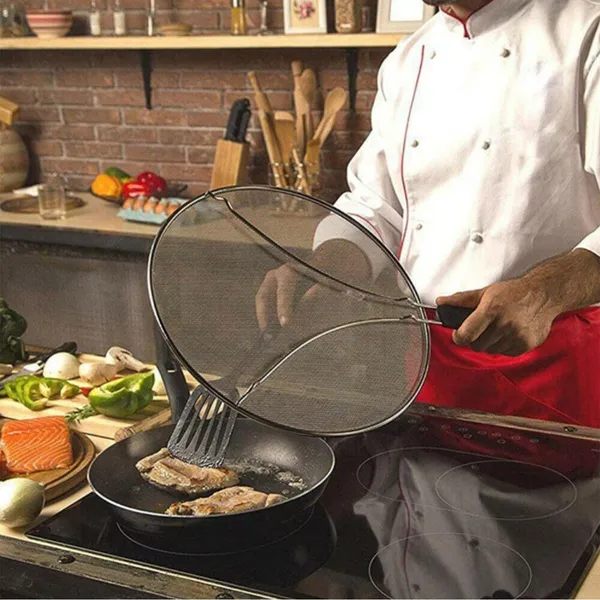

Photos from current listings. Actual item, color, and included accessories may vary.
Splatter Screen Buying Guide
A splatter screen is a fine-mesh guard that fits over a pan to block hot oil while letting steam escape. The key trade-off is mesh fineness versus airflow and durability: finer mesh stops more grease but clogs and tears faster, while coarser mesh breathes better but lets spatter through. Choose a stainless-steel mesh with a rigid rim and a heat-safe handle if you fry often; skip flimsy nylon-handled or loose-weave versions that warp or melt.
Key takeaways
- Mesh grade determines splatter blocking: 18/8 stainless steel woven mesh at 30-40 wires per inch stops fine oil droplets; coarser 20-wire mesh passes grease.
- Handle material is the failure point: silicone-over-steel and riveted stainless handles withstand 450-500°F; nylon or plastic handles deform above 400°F.
- Rim construction separates durable from disposable: double-rolled or hemmed stainless rims resist warping; thin unrolled edges bend and let the screen sit unevenly.
At a glance
- Category
- Cookware & Cutlery
- Last updated
- Nov 28, 2026
Current offers
Highlights
- Mesh grade determines splatter blocking: 18/8 stainless steel woven mesh at 30-40 wires per inch stops fine oil droplets; coarser 20-wire mesh passes grease.
- Handle material is the failure point: silicone-over-steel and riveted stainless handles withstand 450-500°F; nylon or plastic handles deform above 400°F.
- Rim construction separates durable from disposable: double-rolled or hemmed stainless rims resist warping; thin unrolled edges bend and let the screen sit unevenly.
- Universal sizing: most screens are 11-13 inches in diameter, fitting 8-12 inch pans; a screen should overhang the pan rim by at least 1 inch for full coverage.
Best use cases
- Best fit: daily pan-frying and deep-frying in 10-12 inch skillets — pick a 13-inch stainless screen with a silicone-wrapped stay-cool handle and fine 30+ wire mesh.
- Best fit: occasional bacon or shallow-frying in 8-10 inch pans — an 11-12 inch screen with a folding handle saves cabinet space and still blocks most spatter.
- Wrong fit: high-heat wok cooking or open-flame gas burners — screens trap heat and flame, and most handles are not rated above 500°F; use a wok ring and lid instead.
- Wrong fit: nonstick pans used above medium heat — a screen restricts airflow and can overheat the coating; choose a vented lid or lower heat instead.
Buying tips
- Match screen diameter to your largest pan plus 1 inch: an 11-inch screen suits 10-inch pans, a 13-inch screen suits 12-inch pans; undersized screens leave a spatter gap.
- Choose 304 (18/8) stainless mesh over galvanized or coated mesh — 304 resists rust and acidic foods, while coatings flake after repeated washing.
- Look for a riveted, not spot-welded, handle joint; spot welds crack after dishwasher cycles and heat expansion.
- Prefer dishwasher-safe screens with fully sealed rims; open rims trap oil and water and rust from the inside out.
Specs
| Mesh Material | 304 stainless vs galvanized |
|---|---|
| Mesh Fineness | 20-40 wires per inch |
| Handle Heat Rating | 400-500°F (silicone/stainless) |
| Screen Diameter | 11-13 in (fits 8-12 in pans) |
Related searches
What to check before buying
- Measure your most-used pan's outer rim diameter; add 1 inch to select screen size — do not rely on nominal pan size alone.
- Confirm your cooktop type: gas open-flame burners require a stainless handle rated 500°F+; electric and induction are more forgiving.
- Check cabinet storage height: folding or collapsible handles fit shallow drawers; fixed handles need 2-3 inches of vertical clearance.
- Verify dishwasher compatibility of the handle and rim; hand-wash-only screens with wooden or wrapped handles degrade quickly.
FAQ
Data sources: eBay / Amazon listings and product attribute feeds. Updated Nov 28, 2026.
Some links on this page are affiliate links. If you buy after clicking one, we may earn a commission at no extra cost to you. This does not change which products appear here or their order. Affiliate disclosure.