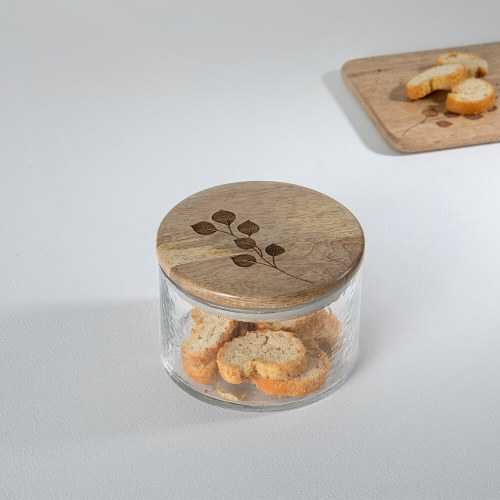

Photos from current listings. Actual item, color, and included accessories may vary.
Glass Container With Wood Lid Buying Guide
Glass containers with wood lids combine inert, non-porous borosilicate or soda-lime glass bodies with tight-fitting wooden closures for pantry, fridge, and countertop storage. The primary trade-off is wood species and seal architecture: acacia/bamboo lids with silicone gaskets resist moisture and odor, while unsealed pine or MDF lids warp and harbor bacteria. Choose borosilicate glass with a food-grade silicone-gasketed hardwood lid for daily wet or oily foods; skip thin soda-lime glass with unlined composite lids for anything beyond dry goods.
Key takeaways
- Borosilicate glass (low thermal expansion ~3.3) survives freezer-to-oven shifts; soda-lime glass can shatter above ~120°C differential.
- Acacia and bamboo lids are dense hardwoods that resist warping; pine and MDF lids swell and crack with repeated dishwashing moisture.
- A food-grade silicone gasket (often 1-3 mm) creates the airtight seal; unlined wood-to-glass contact is moisture-permeable and not leakproof.
At a glance
- Category
- Food Storage & Containers
- Last updated
- Nov 28, 2026
Current offers
Highlights
- Borosilicate glass (low thermal expansion ~3.3) survives freezer-to-oven shifts; soda-lime glass can shatter above ~120°C differential.
- Acacia and bamboo lids are dense hardwoods that resist warping; pine and MDF lids swell and crack with repeated dishwashing moisture.
- A food-grade silicone gasket (often 1-3 mm) creates the airtight seal; unlined wood-to-glass contact is moisture-permeable and not leakproof.
- Lid thickness of 12-18 mm with a recessed inner lip seats stably; thin 6-8 mm flat lids slide and fail to clamp.
Best use cases
- Best fit: borosilicate glass + acacia lid + silicone gasket for meal-prep, leftovers, and oily sauces in fridge or pantry.
- Best fit: bamboo lid with gasket on wide-mouth jars for dry goods (pasta, grains, coffee) on open shelving where appearance matters.
- Wrong fit: thin soda-lime glass with unlined pine lid for freezer storage or microwave reheating — thermal shock and moisture warping risk.
- Wrong fit: decorative wood-lid containers without gaskets for transporting liquids in bags — they are not leakproof.
Buying tips
- Match glass type to use: borosilicate for oven/freezer cycles; soda-lime is fine for pantry dry goods only.
- Confirm a removable food-grade silicone gasket — lids without one are aroma-permeable and not leak-resistant.
- Check lid underside: a recessed lip or stepped rim that sits inside the glass mouth seals far better than a flat plate lid.
- Prefer hardwoods (acacia, bamboo, beech) over softwoods or MDF; hand-wash wood lids to prevent warping and delamination.
Specs
| Glass Type | Borosilicate vs soda-lime |
|---|---|
| Lid Material | Acacia / bamboo / pine / MDF |
| Seal Type | Silicone gasket vs unlined wood |
| Thermal Use | Oven/freezer-safe vs pantry-only |
Related searches
What to check before buying
- Measure cabinet/shelf height and container footprint — wood lids add 12-18 mm above the glass rim.
- Verify glass is marked borosilicate or tempered if you plan oven, microwave, or freezer use.
- Confirm the gasket is replaceable and food-grade silicone, not EVA foam or TPR that degrades.
- Check lid fit: the wood should seat flush with slight resistance and no rocking on the glass rim.
FAQ
Data sources: eBay / Amazon listings and product attribute feeds. Updated Nov 28, 2026.
Some links on this page are affiliate links. If you buy after clicking one, we may earn a commission at no extra cost to you. This does not change which products appear here or their order. Affiliate disclosure.